
ChatGPT’s share of total AI prompt volume fell from 70% to 50% between January and June 2026, while Gemini rose from 17% to 30% and Claude from 2% to 11%, according to Comscore’s 2026 AI Intelligence Report coverage. That shift changes what prompt management means. It’s no longer mainly about writing a clever instruction once. It’s about maintaining a living test set of buyer questions, running them across assistants, and tracking whether your brand is recommended, compared, cited, or omitted.
A prompt is now a visibility measurement asset. Its wording, model, sources, answer position, competitor overlap, and historical results all matter. Teams that store only prompt text miss the operational evidence needed to understand why an answer changed and what to do next.
Why Prompt Management Matters Now
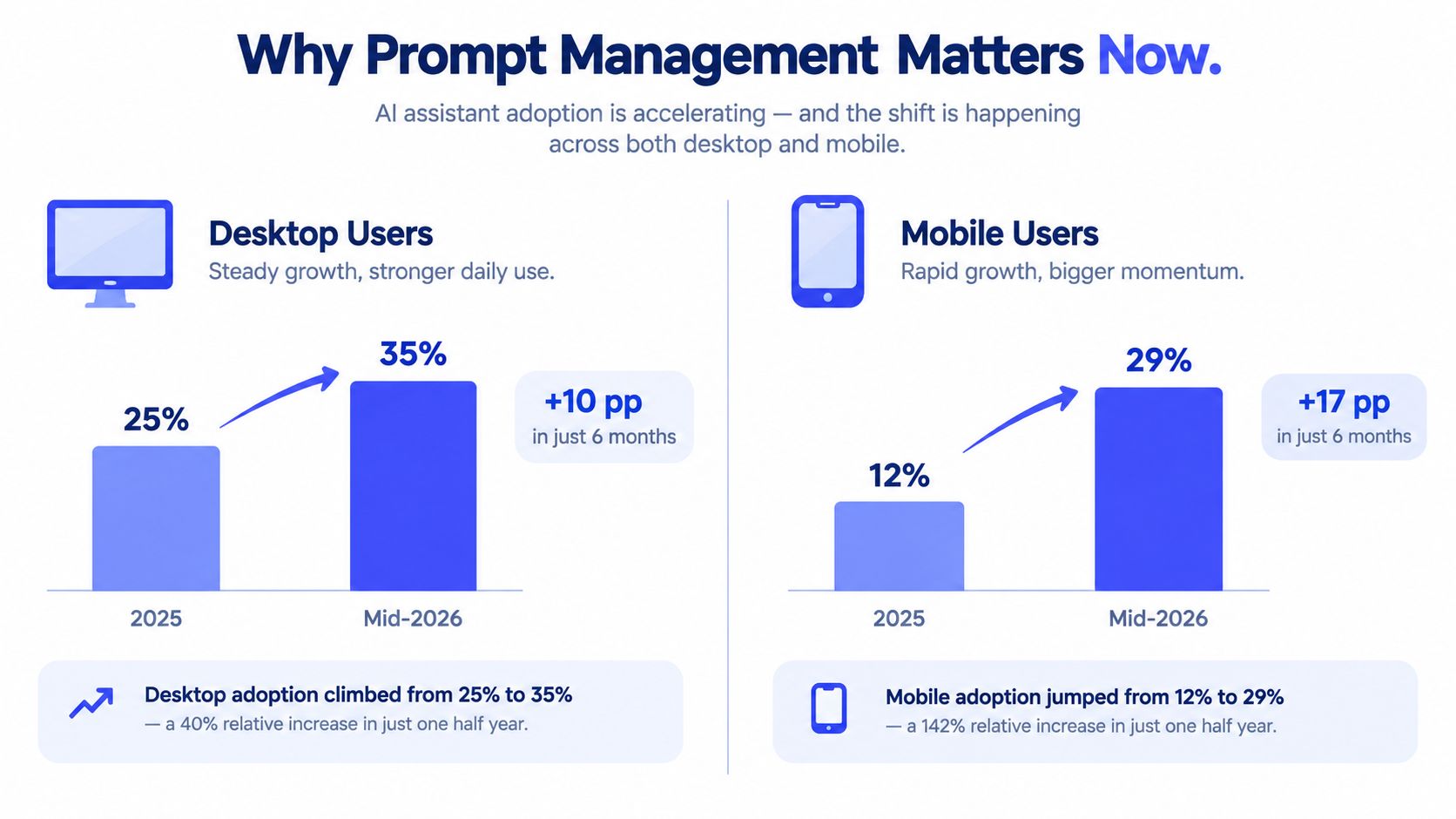
AI assistant visitation reached 35% of desktop users and 29% of mobile users in June 2026, compared with 25% and 12% respectively in January 2025, based on the Comscore report. Buyers are encountering brands through several assistants, so one ChatGPT check cannot represent the market’s full discovery path.
The platform mix also changes quickly. ChatGPT recorded 168 million desktop conversations in June 2026, while multiplatform visitation reached 99 million, up from 59 million a year earlier, according to Comscore’s reporting. These figures do not show whether a particular company appears in an answer. They do show why teams should test commercial prompts across ChatGPT, Gemini, Claude, and Perplexity, where the brands, evidence, and recommendations may differ.
Ad hoc checks create false confidence
Manual prompting helps with exploration, but it creates weak evidence for ongoing decisions. One person asks a question, sees an answer, and records an impression. Another uses different wording, account context, or an assistant. Without a fixed test set and history, the team cannot separate a visibility change from a prompt change, competitor substitution, or source update.
Prompt management turns those checks into a repeatable monitoring operation:
- A defined test set: Buyer-style questions cover recommendations, comparisons, pricing, implementation, alternatives, and risk.
- A repeatable schedule: The same prompts run across selected assistants, preserving answer history for comparison.
- Response-level evidence: Teams retain complete answers, citations, links, answer position, and framing.
- Operational ownership: An assigned reviewer approves prompt versions, examines changes, and connects findings to content or positioning work.
The history of prompting matters mainly because it shows how prompts became an operational control layer. OpenAI’s GPT-3 research introduced a model that adapted to tasks from examples embedded in prompts. Prompting methods gained wider practical attention in 2022, and prompt engineering became a recognized AI skill and job title by 2023, as described in this history of prompt engineering. The monitoring requirement followed naturally: teams needed to organize, test, reuse, and govern prompts instead of treating them as disposable copy.
Practical rule: Treat every important buyer prompt as a monitored research instrument, not as disposable copy.
A useful prompt operation should answer: Where does the brand appear? Which competitors appear instead? Which sources does the assistant cite? Is the brand framed as a recommendation or a risk? Does the result persist across assistants and over time? Tools such as response-level AI visibility dashboard metrics can organize those checks, but the operating discipline comes first. A prompt library with historical results turns isolated answers into evidence about brand visibility.
Building a Buyer-Style Prompt Library
Build the library around customer decisions, not keyword volume. A useful prompt reflects what a buyer might ask while choosing a product, validating a shortlist, replacing an incumbent, or investigating risk. “What is project management software?” reveals broad category language. “Which project management platform suits a distributed product team that needs workflow automation?” tests commercial relevance more directly.
A practical range for most teams is 20 to 50 high-value prompts. It covers important buying situations without creating an archive that nobody can review. The goal is a repeatable test set, not a large collection of loosely related questions. Guidance on monitoring brand visibility in AI answers also supports monitoring prompts as part of ongoing visibility work.
Select prompts by decision context
Group prompts by intent and journey stage:
- Category discovery: Which tools solve a defined problem?
- Shortlist formation: Which vendors suit a specific company type or use case?
- Comparison: How does your brand compare with named alternatives?
- Validation: What are the strengths, limitations, integrations, or implementation risks?
- Recommendation: Which option should a buyer choose under stated constraints?
- Caution and replacement: What should a buyer avoid, and which incumbent alternatives deserve consideration?
Include direct brand prompts, then test the questions buyers ask without naming you. Competitor and category prompts often expose omission more clearly because the assistant must decide which brands to introduce. Keep the audience, constraints, and comparison set stable between runs. Otherwise, a changed result may reflect a changed test rather than a change in assistant behavior.
Store prompts as structured assets
Keep prompts in a central registry outside application code, following enterprise guidance on centralized prompt management. Each record should contain a stable identifier, prompt text, intent category, funnel stage, market, platform list, owner, status, and creation date. Add competitor names, expected answer characteristics, and notes describing material changes.
Use clear names such as saas-comparison-finance-teams-v1 or analytics-recommendation-enterprise-security-v2. Keep the identifier stable while creating a new version when wording changes. Mark prompts as active, experimental, paused, or retired so outdated questions do not remain in production monitoring unnoticed.
Run active prompts on a consistent schedule across the assistants relevant to your audience. Capture the full response, cited sources, linked domains, answer position, and surrounding context. Daily reruns can show volatility, while lower-priority prompts may need less frequent checks. A single answer is an anecdote. A dated sequence of comparable answers supports decisions.
Use guidance for writing useful prompts for AI visibility research to turn customer questions into clear, repeatable monitoring inputs. Over time, the library becomes a test set for brand visibility, not a one-time content exercise.
Versioning and Governance Controls
Prompt governance should work like release management. If a prompt feeds a recurring visibility report, changing its wording without preserving the previous state breaks the trend line. A brand may appear to improve because the revised question became easier to answer.
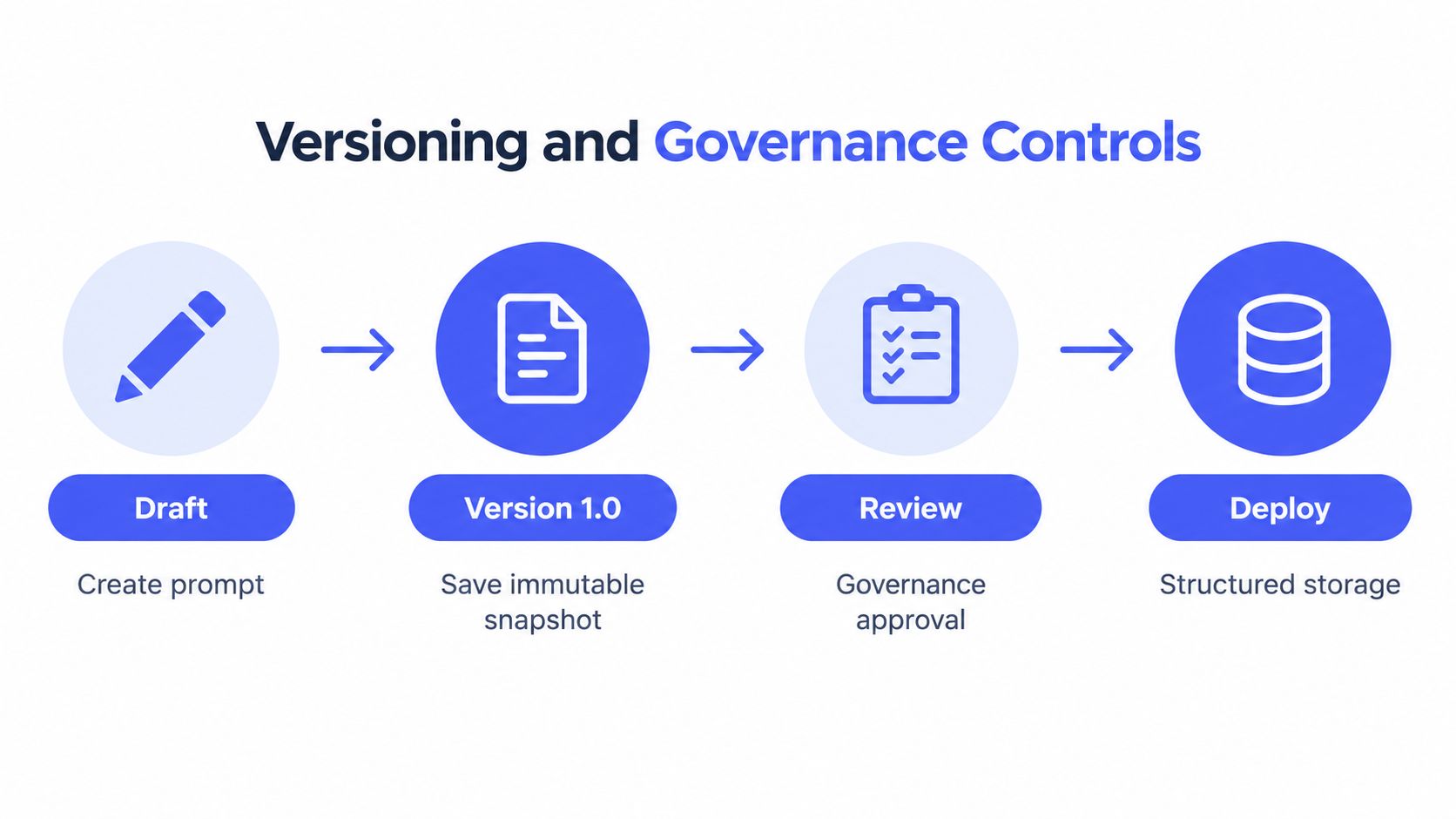
Create an immutable snapshot for every edit. Store the exact text, reason for the change, author, timestamp, and status. Move each new version through a controlled path such as draft, staging, review, and production. Never overwrite the earlier version, even when the edit seems minor. A single qualifier can change which brands an assistant mentions or which sources it selects.
Separate experimentation from live tracking
A staging prompt can test a new market, competitor, or buyer constraint. A production prompt must remain stable enough for historical comparison. Keep staging and production prompts in separate registry states so rollback is a pointer change, not a rewrite. Retrieve the approved prompt at runtime from the central registry instead of embedding it in application code. This reduces deployment coupling and keeps live tracking separate from experimentation.
Before promotion, replay the revised prompt against a known evaluation set. Check whether its wording preserves the intended buyer context, treats competitors consistently, and produces answers comparable with earlier runs. Automated checks can flag missing variables, accidental duplication, or unexpected structural changes. Human review still decides whether the prompt matches commercial intent and brand-safety requirements.
Capture provenance at response level
A useful audit record connects each prompt to its result. Log:
- Prompt identity and version: The exact text and immutable release label.
- Execution context: Assistant, model version, date, market, and relevant settings.
- Tool activity: Search, retrieval, browsing, or other tools used during execution.
- Output evidence: Complete response, citations, linked sources, mention classification, and position.
- Decision history: Reviewer, approver, promotion decision, and reason for change.
This record helps analysts determine whether a visibility change came from prompt wording, model behavior, source changes, or a competitor’s new content. Apply the same discipline to directories, duplicate detection, context snapshots, and audit trails. Guidance on AI data governance for provenance and auditability supports recording the origin, context, and review history needed to reproduce changed answers.
Release principle: If you cannot reproduce the prompt and the answer, you do not have a reliable trend. You have a screenshot.
Assign ownership by prompt group so departments do not create near-duplicate buyer questions independently. Review the registry regularly for overlapping prompts, stale assumptions, and wording that no longer reflects the market. That review keeps the library useful as an ongoing test set for brand visibility.
Execution history makes these controls practical. Teams can use prompt execution history for review and investigation to connect a changed answer with the underlying run instead of relying on recollection. Historical records then show whether a shift reflects a real change in brand visibility or a change in the test itself.
Measuring Visibility and Framing
Binary mention tracking is too blunt for commercial research. A brand may appear in an answer yet fail to influence the decision. Measure how the assistant presents the brand, where it appears, and which competitors surround it.
Use classifications that separate recommendation, comparison, reference, passing mention, and cautionary context. Combine them with position, framing, citation, and competitor data.
| Prompt category | Primary signal | What it helps you decide |
|---|---|---|
| Recommendation | Whether the brand is actively suggested | Whether positioning supports shortlist formation |
| Comparison | Brand position and treatment beside alternatives | Whether competitors own the decision frame |
| Reference | Context and source attribution | Whether the brand has recognized authority |
| Passing mention | Depth and usefulness of the mention | Whether visibility is present but commercially weak |
| Cautionary context | Negative or warning language | Whether objections or reputation issues shape demand |
A recommendation is not the same as a reference. A comparison may favor a competitor, while a passing mention can signal category awareness without giving buyers a reason to investigate. Review cautionary context separately because surrounding language can affect trust even when the brand is technically visible.
Track the answer, not only the mention
Record the brand’s position and the language around it. Is it included in the opening recommendation, buried in a long vendor list, or introduced after a competitor? Does the response describe it as suitable for the use case, expensive, difficult to implement, narrowly specialized, or missing a capability?
Track citations alongside framing. A review, comparison page, directory, or editorial article reveals which external sources may be shaping the answer. The operational question is not merely whether the brand earns more mentions. Identify the sources that repeatedly influence commercial framing, then check whether your own pages, third-party coverage, and product evidence address the same buyer questions.
Historical tracking turns these observations into a test. Run the same buyer-style prompts, store the same fields, and compare results across runs. Record visibility, position, framing, cited domains, and competitor presence so analysts can distinguish a wording change from a genuine shift in brand visibility.
Review the history on a schedule that matches market movement. Citation patterns often shift fastest after a competitor publishes a comparison page, so weekly source review can matter more than a monthly check. A stable prompt library makes those changes visible and gives the team a defensible basis for deciding which content or proof to update.
From Prompts to Actionable Insights
A prompt library becomes strategically valuable when it changes what the team does. Consider a hypothetical mid-market SaaS company that monitors buyer questions about budget, integrations, implementation, and feature fit. Its brand appears positively in feature comparisons but repeatedly enters cautionary context when buyers ask which platform is appropriate for a constrained budget.
That split points to a positioning problem, not a prompt-writing problem. The product may have strong capability evidence but weak explanations of total cost, onboarding effort, or suitability for smaller teams. A content team can respond with clearer implementation documentation, customer proof, comparison pages, and expert commentary that address the specific concerns appearing in answers.
Connect visibility changes to concrete work
Don’t treat every fluctuation as a content win or loss. Create an evidence chain:
- Identify the pattern: The same buyer prompt produces repeated omission, weak framing, or competitor preference.
- Inspect citations: Determine which sources support the current answer.
- Map the gap: Compare the answer’s claims with the brand’s pages, proof, product documentation, and third-party coverage.
- Make a targeted change: Improve the source most relevant to the missing or distorted information.
- Continue the same test: Keep the prompt wording and platform constant while recording the intervention.
This process prevents broad, unfocused publishing. If comparison prompts are healthy but recommendation prompts are weak, producing more generic category content may do little. A smaller set of high-stakes purchase questions can provide clearer priorities than broad topical coverage, particularly when visibility is concentrated in specific query types.
The company should also watch for competitor displacement. If a rival moves from a passing mention to the opening recommendation after new comparison coverage appears, that change deserves investigation. The response may reveal a missing use case, stronger third-party validation, clearer language, or a source the assistant trusts more.
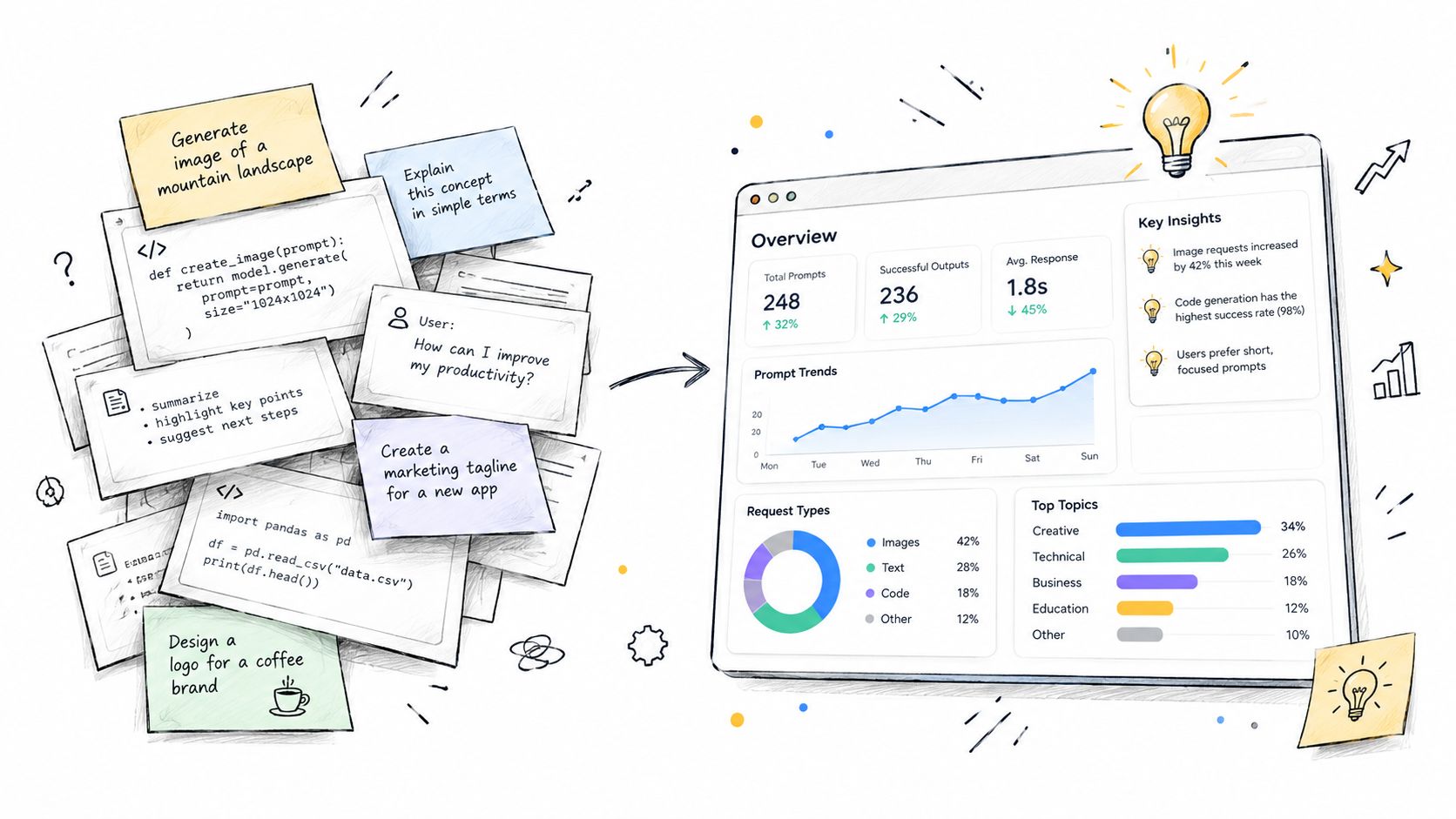
A monitoring dashboard should help people move from detection to action. Useful outputs include trend charts, historical response archives, cited-source lists, competitor parity, position changes, framing labels, and alerts for new omissions or cautionary language. Teams can then bring the evidence into SEO briefs, digital PR planning, product marketing, and executive reporting instead of keeping AI visibility isolated in an experimental channel.
The strongest operating rhythm is analytical rather than reactive. Review patterns by prompt group, platform, and intent. Ask which changes are persistent, which are isolated, and which source relationships deserve attention. Prompt management works when it helps the team choose the next credible action.
Implementing Your Prompt Management System
Start with a deliberately small pilot. Select your top five buyer prompts and run them across your two most important assistants. Record the complete answers, citations, brand position, framing, competitor presence, and any obvious omissions. Keep the wording fixed during the initial baseline period so the team can distinguish platform volatility from prompt changes.
Document the operating procedure while the pilot is still manageable:
- Define ownership: Assign one person to maintain the registry and reviewers for material changes.
- Set the schema: Store prompt text, intent, version, platform, date, response, citations, classification, and action notes.
- Create a review rhythm: Separate daily collection from weekly interpretation so nobody confuses new data with a conclusion.
- Connect findings to workflows: Add visibility gaps to content briefs, technical reviews, digital PR plans, and positioning discussions.
- Expand selectively: Add prompts or platforms only when the team can preserve consistent tagging and response analysis.
The system should complement SEO, not compete with it. Citation findings can inform outreach and editorial coverage. Framing issues can shape product messaging. Repeated omissions can reveal pages that need stronger evidence, clearer structure, or better alignment with buyer questions.
Operating standard: Scale the library only when each prompt still has an owner, a purpose, and a decision attached to its results.
Review the library periodically for duplicates, outdated assumptions, inactive products, changed competitors, and prompts that no longer represent real buying situations. Retire weak tests instead of preserving them for the appearance of breadth. A smaller, well-maintained set produces better trend intelligence than an archive nobody can interpret.
LiveMentions runs buyer-style prompts across ChatGPT, Claude, Gemini, and Perplexity, captures full answers and citations, and tracks brand presence, position, framing, and competitor overlap over time. Visit LiveMentions to turn prompt management into a repeatable AI visibility monitoring workflow for your brand.
Ready to see your own AI visibility?
Start Free Trial
Shahin Salehin
I’m Shahin, founder of LiveMentions and a software product builder with years of experience building WordPress plugins and tools for real businesses. My work has given me a practical perspective on product development, search, content, and how businesses build visibility online. With LiveMentions, I’m now focused on AI search and helping brands understand how they are represented across AI-generated answers. I write about AI brand visibility, AI search, and practical strategies based on research, experimentation, and what I learn from building in this space.
Articles: 7