
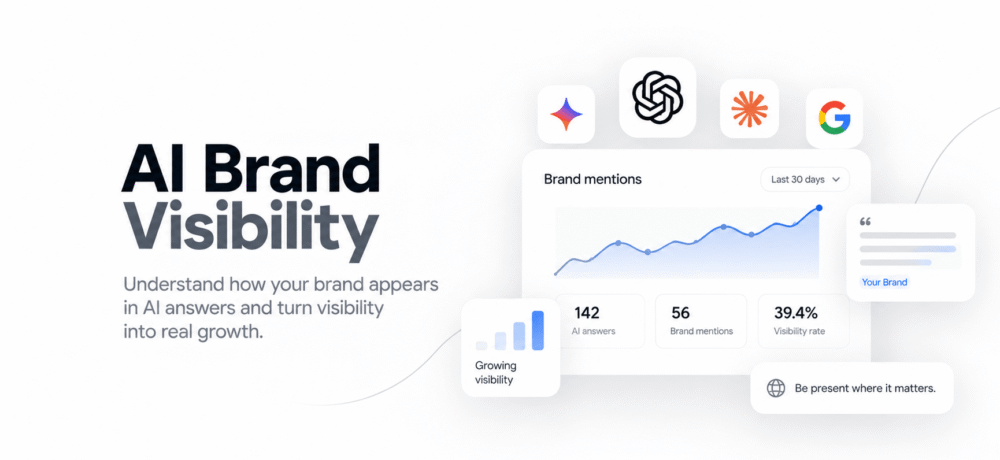
People are changing the way they discover products, companies, and answers. Instead of always starting with a traditional search engine, they are increasingly asking AI systems questions directly.
That creates a new question for brands: when potential customers ask AI about your category, does your brand appear in the answer?
This is where AI brand visibility comes in. It is a way to understand how often and in what context a brand appears in relevant answers generated by AI search engines and AI assistants.
AI brand visibility does not replace traditional SEO. It adds another layer of measurement. Search rankings tell you where a website appears in a search engine results page. AI visibility asks what happens after someone asks an AI system a question and receives a generated answer.
In this guide, we will define AI brand visibility, explain what to measure, show how to establish a baseline across major AI platforms, and look at what brands can do when they are missing from relevant AI answers.
What Is AI Brand Visibility?
AI brand visibility is the extent to which a brand appears in relevant answers generated by AI search engines and AI assistants.
That definition sounds simple, but visibility is more than a brand-name mention. A useful measurement system should help answer questions such as:
- Does the AI mention the brand?
- How often does it mention the brand?
- Which questions or prompts trigger the mention?
- Is the brand recommended, compared, or simply listed?
- Which competitors appear in the same answers?
- Which sources and pages are cited?
- How does visibility change over time?
For example, imagine a software company that tracks 100 relevant AI answers. If its brand appears in 24 of those answers, its measured visibility for that dataset is 24%.
The important point is that the number is tied to a defined set of prompts, platforms, and time period. There is no single universal AI visibility percentage that applies to every brand.
Why AI Brand Visibility Matters
Traditional search and AI-assisted discovery work differently.
An AI answer can introduce a person to a company before that person visits the company’s website. It can also compare several products, recommend specific tools, explain a category, or cite sources that support the answer.
That means brands need to understand not only whether their website can be found, but also how their brand is represented when relevant questions are answered by AI.
How AI Systems Mention Brands
Brand visibility can take several forms. These should not all be treated as the same signal.
Brand mentions
The brand name appears somewhere in the generated answer. This is the most direct form of visibility.
Recommendations
An AI system suggests the brand as an option for a particular need or use case.
Comparisons
The brand appears alongside competitors in an answer that compares products, companies, services, or approaches.
Citations
The AI answer references or links to a source that supports part of the response. A citation is not necessarily the same thing as a brand mention. A page can be cited without the brand being prominently recommended, and a brand can be mentioned without a direct citation to its website.
Descriptions
An AI system may describe what a company does, who it serves, or what a product is used for. Accuracy matters here because visibility is not useful if the underlying description is misleading.
AI Brand Visibility vs. Traditional SEO
AI brand visibility and SEO overlap, but they answer different questions.
This does not mean that SEO is becoming irrelevant. A technically sound, useful, well-structured website remains important. AI visibility is better understood as an additional layer of brand discovery and measurement.
Which AI Platforms Should You Monitor?
If AI brand visibility is part of your marketing strategy, monitoring a single AI system gives you only a partial view.
ChatGPT
Track how your brand appears when users ask commercial, informational, comparison, and category questions.
Claude
Monitor relevant questions and comparisons to see when the brand is included and how it is described.
Gemini
Track brand visibility across questions related to your products, category, competitors, and use cases.
Perplexity
Pay attention to both brand mentions and the sources cited alongside the generated answer.
The same prompt can produce different answers across platforms. Models, retrieval systems, available sources, context, and response generation can all vary. For that reason, a cross-platform baseline is more useful than treating one AI system as a complete representation of AI search.
What Should You Measure?
There is no single metric that explains AI brand visibility. A useful measurement system combines several signals.
1. Visibility
Visibility can be expressed as the percentage of tracked AI answers in which your brand appears.
Visibility % = AI answers mentioning your brand ÷ total AI answers × 100
For example, if a brand appears in 24 out of 100 tracked answers, its visibility for that dataset is 24%.
The denominator matters. A percentage without knowing which prompts, platforms, date range, and sample size were used is difficult to interpret.
2. Mention frequency
Count how often the brand appears in the tracked answers. Raw mention counts are useful, but they should be interpreted alongside the number of prompts and responses being monitored.
3. Mention context
Ask why the brand was mentioned. Was it recommended? Was it compared with a competitor? Was it included in a list? Was the description accurate?
Two brands can have the same number of mentions while receiving very different kinds of visibility.
4. Competitor visibility
Look at which competitors appear in the same answers. More importantly, identify questions where competitors appear but your brand does not.
This can reveal gaps in the topics, use cases, and questions associated with your brand.
5. Sources and citations
Track which websites, pages, and domains are cited in relevant AI answers. Repeated sources can reveal part of the information ecosystem that AI systems use when answering questions in your category.
6. Visibility over time
One AI answer is only a snapshot. AI responses can change as models, sources, prompts, and your own online presence change.
Historical tracking lets you see whether visibility is stable, increasing, decreasing, or changing across specific topics and platforms.
How to Create an AI Visibility Baseline
Before trying to improve AI visibility, establish a baseline. The goal is to measure the current state using a repeatable set of questions.
Step 1: Define your category
Start with the category or problem your customers associate with your company.
For example, a company building AI search monitoring software might start with topics such as AI search monitoring, AI brand visibility, AI SEO, and generative engine optimization.
Step 2: Create relevant topics
Organize the subject into meaningful groups. Topics should represent what your brand wants to be known for, not simply a list of high-volume keywords.
Step 3: Turn topics into real questions
AI systems respond to questions and instructions, so monitoring should include realistic prompts.
- What tools can I use to monitor my brand in AI search?
- What are the best AI visibility platforms for SaaS companies?
- How can I track whether ChatGPT recommends my company?
- What should a brand monitor in generative search?
These questions can be expanded into informational, commercial, comparison, and problem-solving prompts.
Step 4: Run the same questions across AI platforms
Run a consistent prompt set across ChatGPT, Claude, Gemini, and Perplexity. Keeping the prompt set stable makes later comparisons more meaningful.
Step 5: Record the answers
For each response, record useful information such as:
- Brand mentioned or not
- Competitors mentioned
- Sources or citations
- Context of the brand mention
- AI platform
- Prompt
- Date of the response
Step 6: Calculate the baseline
Once enough responses have been collected, calculate your visibility using the same definition each time. This gives you a starting point against which future measurements can be compared.
Why Does AI Mention Competitors but Not Your Brand?
This is one of the most useful questions AI visibility monitoring can help answer.
There is no single explanation for every missing mention. AI systems can use different sources, interpret prompts differently, and generate different responses across platforms and dates.
Possible factors include:
- Your brand may have limited representation in sources relevant to the question.
- Your website may not clearly explain what your company does or who it serves.
- Competitors may have stronger topical coverage around the specific use case.
- The prompt may not strongly connect with the information associated with your brand.
- Different AI platforms may have access to different information or use different retrieval and generation processes.
The important lesson is that a single missing mention should not be treated as proof that your brand has poor overall AI visibility. You need a broader sample across relevant prompts and platforms.
How Can You Improve AI Brand Visibility?
Make your website easy to understand
Clearly explain what you offer, who you serve, the problems you solve, and the products or services you provide.
Build topical depth
Create useful resources around the questions your audience actually asks. Cover related concepts, use cases, comparisons, definitions, and practical problems instead of creating pages solely around isolated keywords.
Strengthen relevant third-party presence
Relevant reviews, publications, communities, directories, and industry resources can contribute to the broader information ecosystem around your brand. Focus on legitimate, useful references rather than producing large numbers of low-quality listings.
Monitor sources
Look for domains and pages that repeatedly appear in answers about your category. Understanding those sources can help you identify where useful information about your market is being surfaced.
Track competitors
Competitor visibility can reveal questions and topics where other brands are consistently appearing. This can help you identify areas worth investigating.
Measure continuously
AI visibility is not a one-time audit. Repeated measurements are more useful because they reveal changes over time.
How LiveMentions Measures AI Brand Visibility
LiveMentions is built around the idea that AI brand visibility should be measurable rather than guessed.
The workflow is straightforward:
Topics → Prompts → AI Answers → Mentions → Competitors → Sources → Visibility
- Define topics: Identify the subjects your brand should be associated with.
- Create prompts: Turn those topics into realistic questions that potential customers might ask.
- Run AI queries: Execute prompts across ChatGPT, Claude, Gemini, and Perplexity.
- Capture answers: Store the generated responses for analysis and historical comparison.
- Detect mentions: Identify when the tracked brand appears in the answers.
- Identify competitors: See which other brands appear alongside your brand.
- Analyze sources: Track cited sources and domains associated with relevant answers.
- Calculate visibility: Measure the percentage of tracked AI answers where the brand appears.
- Track changes: Compare results over time to understand how visibility changes.
The goal is not to claim that an AI system has a single permanent ranking position. The goal is to build a repeatable measurement system that shows how a brand appears across a defined set of real questions and AI platforms.
AI Brand Visibility Is a Measurement Problem
Traditional SEO helps answer a familiar question: where does my website appear in search results?
AI brand visibility asks a different question: when people ask AI about my category, does my brand appear in the answer?
Answering that question requires more than checking one prompt once. You need a defined topic set, realistic prompts, multiple AI platforms, stored answers, mention detection, competitor analysis, source tracking, and historical measurements.
Once you can measure visibility consistently, you can start investigating where the gaps are and decide what deserves attention.
Measure first. Understand the gaps. Then decide what to improve.
Frequently Asked Questions
What is AI brand visibility?
AI brand visibility is the extent to which a brand appears in relevant answers generated by AI search engines and AI assistants. It can include direct mentions, recommendations, comparisons, descriptions, and related visibility signals.
How do you measure AI brand visibility?
A practical approach is to create a defined set of relevant prompts, run them across selected AI platforms, record the responses, identify brand mentions, and calculate the percentage of tracked answers that mention the brand. Competitors, context, citations, sources, and changes over time can provide additional insight.
What is an AI visibility score?
An AI visibility score is a measurement intended to summarize how frequently a brand appears across a defined set of AI-generated answers. Different platforms and tools may use different formulas, so the definition and sample behind a score should always be considered.
Which AI platforms should I monitor?
For a broad view, brands can monitor major AI answer platforms such as ChatGPT, Claude, Gemini, and Perplexity. The same prompt can produce different results across platforms, so cross-platform monitoring provides a broader picture.
What is the difference between an AI brand mention and a citation?
A brand mention means the brand appears in the generated answer. A citation is a reference or link to a source used to support the answer. A response can contain a brand mention without directly citing the brand’s website, and a cited source does not necessarily mean the brand is recommended.
Why does my brand appear in some AI answers but not others?
AI responses can vary based on the prompt, platform, available sources, context, retrieval behavior, and generation process. A single response therefore should not be treated as a complete measure of brand visibility.
How often should I monitor AI brand visibility?
Consistent monitoring is more useful than a one-time check. The appropriate frequency depends on your category, how quickly your market changes, and how much data you need for meaningful comparisons.
Can AI brand visibility be improved?
Brands can investigate and improve the information available about them, build useful topical coverage, strengthen relevant third-party presence, and monitor the questions and sources associated with their category. Measurement should come first so that changes can be evaluated against a clear baseline.
Final Takeaway
AI search is creating a new environment in which brands can be discovered, compared, recommended, and described inside generated answers. AI brand visibility gives businesses a way to measure that presence.
Start with real questions, monitor multiple AI platforms, capture the answers, measure mentions and sources, and track the results over time. That turns an abstract idea like “AI visibility” into something you can actually observe and measure.
Ready to see your own AI visibility?
Start Free Trial
Shahin Salehin
I’m Shahin, founder of LiveMentions and a software product builder with years of experience building WordPress plugins and tools for real businesses. My work has given me a practical perspective on product development, search, content, and how businesses build visibility online. With LiveMentions, I’m now focused on AI search and helping brands understand how they are represented across AI-generated answers. I write about AI brand visibility, AI search, and practical strategies based on research, experimentation, and what I learn from building in this space.
Articles: 7