
A single rank score no longer explains visibility. Traditional rank monitoring software records where a URL appears for a keyword, but buyers may also encounter your brand inside an AI-generated answer that summarizes, compares, cites, or omits competing providers. A page can retain a strong organic position while receiving less attention when search features and synthesized answers occupy more of the results experience. A 2024 academic study illustrates the commercial logic behind position tracking: estimated click-through rate was 9.28% for the first organic result, 5.82% for the second, and 3.11% for the third, based on Google Search Console data (academic study of search click-through rates).
AI-answer monitoring is a different measurement problem. It must preserve the exact prompt, complete response, citations, mention position, and framing, because “named,” “cited,” and “recommended” describe different outcomes. This comparison therefore evaluates evidence quality, refresh cadence, keyword and prompt coverage, geographic and SERP depth, integrations, reporting, scalability, and operational limitations. LiveMentions is the specialist choice for traceable AI-answer evidence. The other platforms range from pure-play rank trackers to broad SEO suites that increasingly add AI visibility features.
1. LiveMentions
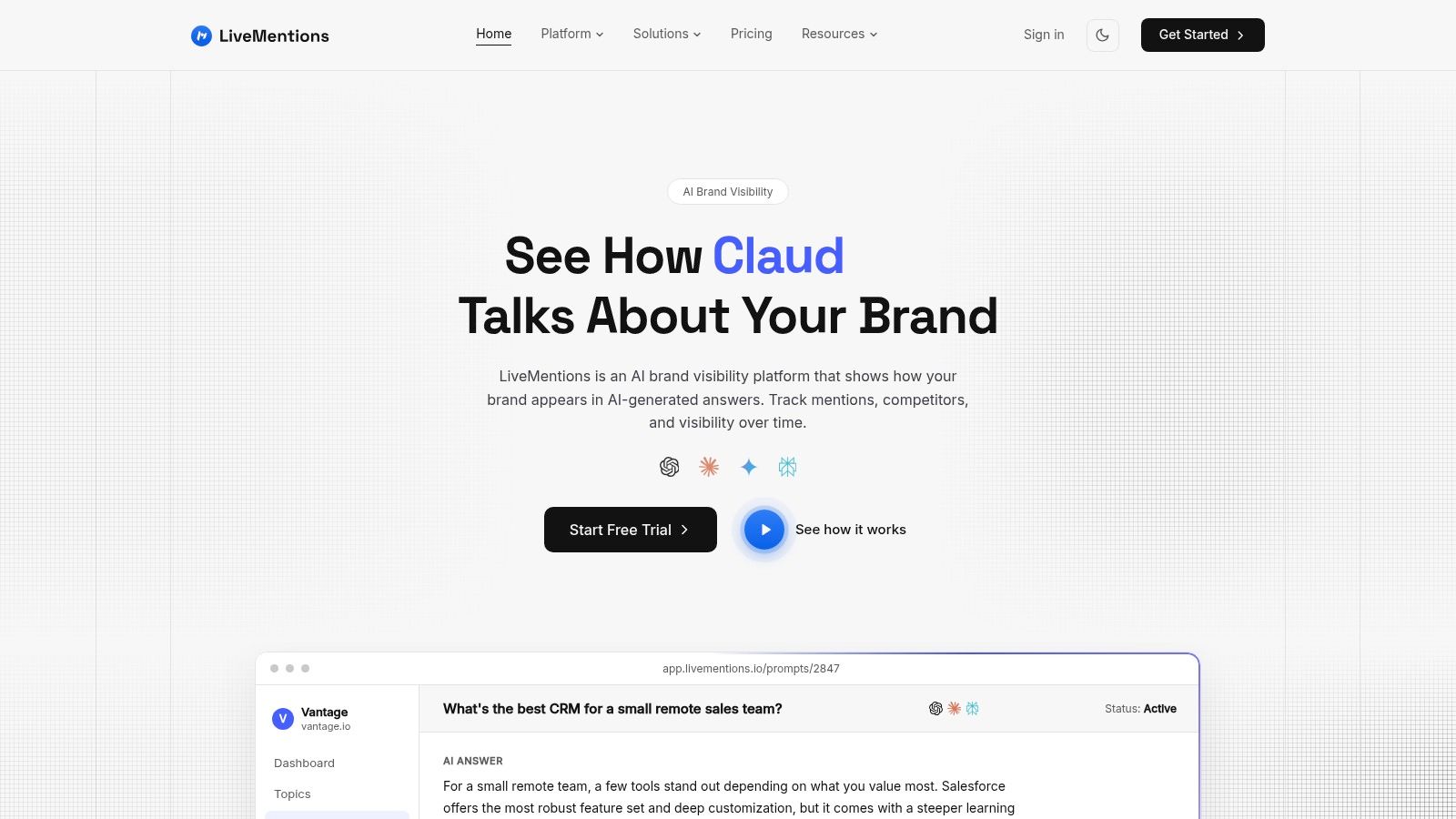
LiveMentions is the strongest fit when your team needs to know what AI assistants say about a brand, not merely whether a domain appears in a conventional search result. It runs curated, buyer-style prompts across ChatGPT, Claude, Gemini, and Perplexity, then captures the full answer and cited sources. That distinction matters because a visibility score without the underlying response can't show whether your company was the first recommendation, a passing reference, or mentioned negatively.
The platform preserves prompt-level evidence, including wording and context, so marketers can inspect the observation behind a trend. It also compares competitors on identical prompts, tracks position within the answer, and classifies framing as recommended, compared, referenced, passing mention, or negative. Citation analysis adds a second layer of diagnosis by showing which domains influence the narrative around a category.
Evidence that leads to action
LiveMentions doesn't stop at reporting. Its Optimize audit produces a 10-step sequence of recommendations ranked by impact, confidence, and effort, then validates findings against live search and on-site signals. Dashboards combine historical trends, prompt-level outcomes, competitor comparisons, and GEO or traffic insights. Email and Slack alerts help teams react to meaningful changes without asking stakeholders to inspect every answer manually.
The operational model suits B2B marketers, content strategists, growth leads, communications teams, and agencies. Unlimited team seats support cross-functional review, while MCP connections for Claude, Cursor, and n8n can bring monitoring into existing workflows. API access is available on Scale plans, giving technical teams a route to custom automation.
Practical rule: Treat an AI visibility score as a starting point. The response, citation set, and framing are the evidence your team can act on.
LiveMentions doesn't publish fixed per-seat pricing. Teams can use the no-credit-card free trial, live custom-plan calculator, or contact the company for exact costs and API limits. Its coverage is focused on the major assistants listed above, so teams dependent on niche or emerging models should verify coverage before committing. For traceable, recurring intelligence about how assistants shape buyer discovery, however, it offers the clearest specialist fit.
Website: LiveMentions
2. AccuRanker
AccuRanker is built for teams that already know they need a dedicated, fast rank tracker, rather than another broad SEO workspace. Its daily updates and on-demand checks make it particularly suitable for agencies, in-house SEO teams, and reporting workflows where a ranking change needs investigation before the next scheduled cycle. SERP analysis helps users inspect the result behind the recorded position instead of treating the number as self-explanatory.
The platform supports granular tagging, dynamic segments, share of voice, and forecasting. Those controls matter at scale because a blended average can conceal the difference between brand terms, commercial terms, locations, devices, and competitor groups. Agencies can turn those segments into client-facing reports and exports without rebuilding the dataset elsewhere.
AccuRanker connects with Google Search Console, Google Analytics, BigQuery, and Looker Studio, and it offers read/write API capabilities. Its AI-related metrics, including AI CTR and AI Search Volume, extend the conventional workflow toward search experiences where ranking alone doesn't describe exposure. MCP integrations also give teams an avenue for connecting rank data to operational systems.
Where the measurement boundary sits
AccuRanker's strength is refresh speed and structured SERP data. It isn't positioned as an all-in-one SEO suite, so teams needing site auditing, broad keyword research, or extensive content workflows will likely need additional tools. That narrower scope is an advantage for buyers who want a clean rank-monitoring layer, but a limitation for smaller teams trying to consolidate software.
The pricing model is transparent by keyword volume, although the entry point is higher than some peers. That makes capacity planning easier, but it also means a small program may pay for a level of speed and export depth it doesn't yet require.
Before comparing a position from AccuRanker with a different platform, define the observation conditions. LiveMentions explains why tracking context matters, and the same principle applies to conventional SERPs: location, device, language, date, and result type should remain comparable.
Website: AccuRanker
3. Semrush Position Tracking
Semrush is the practical choice for teams that want traditional rank tracking and broader SEO operations in one environment. Position Tracking monitors daily keyword rankings across devices and locations, stores historical data, and reports share of voice. That makes it useful for multi-site and multi-region programs where ranking data needs to sit beside keyword research, content work, and technical diagnostics.
Its AI visibility capabilities extend the platform beyond blue-link positions. Semrush tracks visibility across ChatGPT, Perplexity, Gemini, and Google AI features, with reports that connect prompt-oriented monitoring to the wider SEO workspace. The main advantage isn't necessarily the individual metric. It's the opportunity to compare conventional performance and AI-answer presence without moving between unrelated systems.
The value of consolidation
Semrush's site audit, keyword research, and content tools make it suitable for teams that want one vendor to support discovery, diagnosis, planning, and measurement. A growing organization can also apply the same project and reporting structure across multiple sites and regions. That reduces tool switching, though it can make the platform harder to evaluate as a pure rank tracker.
The tradeoff is commercial and operational complexity. Add-ons and per-seat costs can increase the total bill, while advanced tracking quotas may be restricted to higher tiers. Teams should map the exact number of sites, locations, keywords, users, and AI prompts they need before treating the base plan as the likely cost.
Geographic consistency is especially important. A rank observed in one market shouldn't be compared casually with a result from another. Teams planning country-level programs should define locations before configuring projects, rather than adding geography after the baseline has already been collected. LiveMentions documents country and location tracking, a useful reference for the same measurement discipline in AI-answer monitoring.
Website: Semrush
4. Ahrefs Rank Tracker
Ahrefs suits SEO teams that want research depth connected to rank tracking. Rank Tracker works alongside Site Explorer, Keywords Explorer, and Site Audit, so users can move from a position change to competitor research, backlink context, or keyword analysis within the same suite. SERP history and competitor tracking add useful context when a ranking movement needs explanation rather than a simple annotation.
The platform also supports portfolios and target-URL tracking, which helps teams organize multiple properties or monitor whether the intended page continues to rank for a query. Extensive historical data windows are valuable for analysts who compare broader trends instead of reacting to one observation.
The main limitation is cadence. Rank Tracker updates weekly by default, so it isn't the natural choice for teams that need daily operational alerts or frequent post-launch checks. That cadence may be sufficient for slower-moving content programs, but it can delay diagnosis when rankings change quickly or when an agency promises frequent client reporting.
Research depth versus refresh speed
Ahrefs is strongest when rank data is one part of a larger research process. A strategist can identify ranking opportunities, examine competing pages, review historical SERPs, and track selected targets without stitching together several platforms. Its plan comparison also makes tracked-keyword quotas relatively clear.
The compromise emerges when a team values immediacy above breadth. More data and users increase cost, and a weekly default means buyers should confirm whether the available schedule matches their reporting requirements. Competitor visibility and position tracking in LiveMentions illustrates a complementary question for AI monitoring: competitor comparison is most useful when the underlying observations remain directly inspectable.
Ahrefs is a good fit for research-led SEO teams, established content programs, and organizations already using its wider suite. It isn't the first recommendation for a high-frequency rank operations desk.
Website: Ahrefs
5. Moz Pro
Moz Pro organizes rank tracking around Campaigns, which gives small and mid-size teams a straightforward way to connect keywords, competitors, site issues, and reporting. It supports multiple search engines per keyword, while familiar Moz metrics such as Domain Authority and Page Authority provide a common vocabulary for teams already using Moz's ecosystem.
The platform also adds AI and GEO functionality, including AI Overviews by keyword and tracked prompts. These features are quota-limited, so buyers should separate the appeal of having AI monitoring in the interface from the actual prompt coverage their program requires. A small test set may fit comfortably, while a broad international program could need additional capacity.
A manageable entry point
Moz Pro's main advantage is usability. Campaign-based organization can make the tool easier for a small SEO team to adopt than a large enterprise analytics environment. Site crawling, keyword research, competitor research, and MozBar extend the workflow beyond position checks without forcing the team to assemble a separate set of beginner tools.
The limitations appear at scale. Update frequency and quotas vary by plan, and the interface and depth may feel less extensive than larger suites for very large programs. Add-ons provide flexibility for more keywords, users, and features, but they also make the final configuration less obvious than the headline plan.
Moz Pro makes sense when the team values a familiar SEO workflow, campaign structure, and a measured entry into AI visibility monitoring. It is less suitable when the primary requirement is highly granular enterprise segmentation or exhaustive prompt-level evidence across a large assistant set.
Website: Moz Pro
6. STAT Search Analytics
STAT is designed for organizations where rank tracking is a large-scale analytics function, not a lightweight check of a few priority keywords. The platform combines daily rank collection with SERP feature insights and share of voice, then lets teams segment results by device, location, tags, and other enterprise dimensions.
That segmentation is the reason to consider STAT over a simpler tracker. A multinational brand or large agency may need to separate markets, product groups, search intents, local outcomes, and SERP features while preserving a common reporting model. Enterprise controls, integrations, and reporting support that kind of governance.
Built for complex reporting
STAT is particularly strong when different stakeholders need different cuts of the same ranking dataset. SEO leads may want share of voice by category, local teams may need location-level visibility, and executives may need a summarized trend. Granular segmentation allows those views to be built from a shared measurement layer rather than maintained in disconnected spreadsheets.
The product is likely excessive for a small program. Pricing is typically quote-based and isn't publicly itemized, which complicates early budget comparison. That isn't necessarily a weakness for an enterprise procurement process, but it does mean buyers must provide a detailed scope before they can assess fit.
STAT also remains focused on SERP analytics. Teams that need full AI response capture, answer framing, and source-level evidence should evaluate an AI-answer specialist separately rather than assuming deep SERP segmentation solves that problem.
For agencies and large brands managing very large keyword sets across markets, STAT is the most operationally credible option in this list. For a founder tracking a small number of commercial terms, its controls will probably exceed the need.
Website: STAT Search Analytics
7. SE Ranking
SE Ranking offers a broad SEO toolkit with daily rank tracking, historical data, competitor sets, and multi-location support. It also covers local pack and mobile tracking, with reporting and automation features that make it practical for agencies and teams managing several projects. The platform's appeal comes from combining capacity flexibility with a route into AI Search monitoring.
Its AI Search add-on tracks Google AI Overviews, AI Mode, Perplexity, and ChatGPT. Optional API access uses credit-based tiers, so technical teams can extend the platform into custom reporting or data workflows when the relevant plan supports it. This structure gives buyers a way to start with conventional monitoring and add AI coverage when the use case becomes clearer.
Flexible, but not entirely simple
SE Ranking is a good fit for teams that want more than rank tracking but don't need the scale or breadth of the largest suites. Historical data and competitor sets support recurring analysis, while location and mobile tracking help local and multi-market programs avoid relying on one generalized position.
The main limitation is configuration. Base-plan prices can vary by region and currency and may require sign-in or checkout to view. Some advanced capabilities, including AI Search or API functions, require add-ons or higher tiers. Buyers should therefore price the complete workflow, not just the core rank-tracking subscription.
The platform's AI coverage also needs to be interpreted carefully. Tracking a brand inside a Google AI feature or an assistant is not the same as storing and reviewing every response context. Teams that need source-level evidence should confirm how much of the answer, citation set, and framing is retained.
SE Ranking is best for growing teams and agencies that want daily conventional tracking, broad SEO functions, and an expandable AI layer without committing immediately to an enterprise platform.
Website: SE Ranking
8. Nightwatch
Nightwatch takes a rank-first approach but adds AI visibility, making it a strong option for agencies with local and Maps-heavy workflows. It tracks Google, Bing, YouTube, Yahoo, DuckDuckGo, and Google Maps, while location granularity helps teams inspect the markets where search visibility converts into visits or enquiries.
The platform also monitors AI prompts and captures AI responses, with quotas determined by plan. On-demand checks are useful when a team needs to investigate a sudden movement rather than wait for the next scheduled run. Three-year SERP history, site audit, keyword and prompt research, reporting, and API access on higher tiers give the platform more range than a bare rank checker.
Agency economics and local depth
Unlimited user seats on all plans remove one common agency constraint. Teams can give access to account managers, specialists, clients, and stakeholders without calculating every viewer as another paid seat. Looker Studio integration strengthens scheduled reporting, especially when agencies already use that destination for client dashboards.
Nightwatch's smaller overall suite is both a benefit and a limitation. It keeps the product oriented around monitoring, but it doesn't offer the same breadth of research and content workflows as a major all-in-one SEO platform. Some advanced API and reporting options also require higher tiers.
AI response capture is useful for inspection, but buyers should still ask how the platform distinguishes a recommendation from a passing mention and whether it preserves the complete source context. A simple AI presence number shouldn't be treated as equivalent to traditional position data.
Nightwatch is most compelling for agencies that value local and Maps tracking, unlimited seats, and competitive keyword economics. It's less suitable for teams seeking a single platform for every SEO research and execution task.
Website: Nightwatch
9. ProRankTracker
ProRankTracker focuses on dedicated rank monitoring with broad reporting flexibility. It tracks organic, video, and Google Business Profile rankings, while AI Overviews, AI Mode, and LLM platform prompts are handled as tracked “Terms.” That shared unit can simplify capacity planning for teams that want conventional and AI-related observations in one account.
The platform's reporting layer is a major differentiator. White-label reports, a Looker or Data Studio connector, and a client app suit agencies that need to present ranking changes without exposing the underlying operational complexity. Bulk instant checks through Insta-Check add a practical investigation tool for teams that need fresh observations outside the normal schedule.
Strong value for tracking-led teams
ProRankTracker is a sensible choice when the buyer's primary requirement is monitoring rather than a broad SEO suite. Clear billing units make it easier to estimate how many keywords, URLs, locations, and AI terms a program can support. That clarity is particularly useful for agencies packaging reporting into recurring retainers.
The tradeoff is limited non-tracking functionality. Teams needing extensive site auditing, content research, or backlink analysis will need companion tools. API access and on-demand updates also require higher tiers, so the basic subscription may not support every automation or investigation workflow.
Treat AI terms as a separate evidence stream from conventional rankings. An AI Mode observation may contain a response and citations rather than a stable URL position, so the reporting view should make that difference clear. Otherwise, a unified dashboard can create false equivalence between two different measurement problems.
ProRankTracker is the value-oriented choice for agencies and SEO teams that want extensive rank reporting, local and mobile coverage, white-label delivery, and a controlled way to add AI surfaces.
Website: ProRankTracker
10. Advanced Web Ranking
Advanced Web Ranking, or AWR, is a mature option for agencies and international brands that need flexible schedules, broad engine coverage, and reporting automation. It tracks across search engines, devices, and locations, while supporting daily, weekly, biweekly, and monthly schedules alongside on-demand updates.
That scheduling range is more than a convenience. Different keyword groups have different monitoring needs, and AWR lets teams avoid applying a single cadence to every observation. Priority commercial terms can receive frequent checks, while slower-moving informational groups can use a less intensive schedule. The result is a more deliberate data-collection plan.
Scale through reporting discipline
AWR includes SERP feature and pixel data, competitor analysis, and share of voice. API support and unlimited users and projects on many tiers make it attractive to agencies that need to distribute data across account teams, analysts, and client reporting systems.
The product's flexibility can also create friction. Pricing tiers and options may feel complex, particularly for a small team trying to compare capacity quickly. Its strongest cost efficiency appears at higher keyword volumes, so a small program may not benefit from the same economics as a large agency account.
AWR remains primarily a conventional search measurement platform. It can show how a page performs across engines and SERP features, but that doesn't automatically reveal how ChatGPT, Claude, Gemini, or Perplexity frame a brand. Teams adding AI monitoring should preserve the assistant response and source context as a separate evidence layer.
AWR is the strongest match for mature agencies, international programs, and organizations that value scheduling control and automated reporting more than an integrated content or AI-answer workflow.
Website: Advanced Web Ranking
Top 10 Rank Monitoring Tools, Feature Comparison
| Product | Core capabilities | Unique value (✨) | Quality (★) | Pricing / Value (💰) | Target audience (👥) |
|---|---|---|---|---|---|
| 🏆 LiveMentions | Daily buyer-style prompts across ChatGPT/Claude/Gemini/Perplexity; full AI answer + citation capture; visibility, position & framing tracking; competitor compare | ✨ Prompt-level evidence & citation analysis; Optimize 10-step audit; unlimited seats; MCP/API | ★★★★★ | 💰 Custom plans · free trial · live calculator | 👥 B2B marketers, SEO/content teams, growth, agencies |
| AccuRanker | Fast daily & on‑demand rank checks; SERP analysis; tagging & forecasting | ✨ Speed + agency-grade reporting; AI metrics | ★★★★☆ | 💰 $ · transparent per‑keyword pricing (higher entry) | 👥 Agencies needing speed, high-volume tracking |
| Semrush (Position Tracking) | Daily position tracking + AI visibility across assistants; multi-location/device; integrates with full SEO suite | ✨ All‑in‑one SEO + AI tracking (site audit, content tools) | ★★★★ | 💰 $$ · add‑ons & per‑seat costs | 👥 Teams wanting integrated SEO + AI visibility |
| Ahrefs (Rank Tracker) | Rank Tracker (weekly by default); deep research, SERP history, competitor data | ✨ Rich research dataset & historical SERP insights | ★★★★ | 💰 $$ · scales with data/users | 👥 SEO researchers, content teams needing deep data |
| Moz Pro | Campaign-based rank tracking, DA/PA metrics, AI/GEO features (quota‑limited) | ✨ Familiar Moz toolset & campaign organization | ★★★ | 💰 $ · add‑ons for extra keywords/users | 👥 Small to mid‑size teams, agencies starting out |
| STAT Search Analytics (Moz) | Enterprise daily ranks & SERP analytics at scale; granular segmentation | ✨ Built for very large keyword sets & multi‑market reporting | ★★★★ | 💰 Quote · enterprise pricing | 👥 Large agencies, enterprise SEO teams |
| SE Ranking | Daily rank tracking, local/mobile, competitor sets; AI Search add‑on & optional API | ✨ Flexible add‑ons and capacity expansion | ★★★★ | 💰 $ · regional pricing; add‑ons for AI/API | 👥 Teams wanting flexible limits and add‑ons |
| Nightwatch | Daily tracking (incl. Maps), AI prompt tracking & capture quotas; unlimited seats | ✨ Strong local/Maps tracking; Looker Studio integration | ★★★★ | 💰 $ · competitive per‑keyword, no per‑seat fees | 👥 Agencies prioritizing local presence |
| ProRankTracker | Daily organic/video/GBP tracking; AI Overviews/LLM terms; white‑label reports | ✨ Insta‑Check bulk checks; clear 'Terms' billing | ★★★★ | 💰 $ · clear capacity units (Terms) | 👥 Value-focused rank monitoring & agencies |
| Advanced Web Ranking (AWR) | Global engine coverage; flexible schedules (daily→monthly); SERP features & API | ✨ Mature reporting, scheduling flexibility, cost efficiency at scale | ★★★★ | 💰 $ · cost‑efficient at mid/high volumes | 👥 Agencies managing large, international keyword sets |
Choose the Measurement Layer You Actually Need
The right rank monitoring software depends on which question your team needs to answer. If the question is, “Where did this URL appear for this keyword in this market and device?”, a conventional tracker remains the correct instrument. If the question is, “What does a buyer hear about our brand when an assistant synthesizes the category?”, you need answer-level evidence, not a more precise blue-link position.
That distinction is commercially important. The 2024 click-through study cited earlier estimated materially different click-through rates for the first three organic positions, with the first result at 9.28%, the second at 5.82%, and the third at 3.11% (the underlying academic research). Rankings therefore remain useful predictors of potential exposure, but they don’t describe whether an AI system cites your site, recommends a competitor, or presents your brand with unfavorable framing.
Choose LiveMentions when you need recurring, traceable evidence from AI-generated answers. Its full response capture, citations, prompt-level history, competitor comparisons, position tracking, framing classification, and source analysis make it the clearest fit for AI-answer intelligence. It is especially relevant for B2B teams, agencies, content strategists, and brand leaders who need to turn observed assistant behavior into a prioritized action plan.
Choose AccuRanker, ProRankTracker, or AWR when traditional rank tracking dominates. AccuRanker favors fast refreshes, on-demand checks, APIs, and agency exports. ProRankTracker suits teams that want dedicated monitoring, white-label reporting, and clear tracking units. AWR is stronger when international scale, scheduling flexibility, and mature reporting automation matter most.
Choose Semrush, Ahrefs, Moz Pro, or SE Ranking when rank monitoring must sit inside a broader SEO suite. Semrush is the most natural fit for teams wanting conventional and AI visibility in one broad workspace. Ahrefs favors research-led teams and historical SERP analysis. Moz Pro offers campaign organization for small and mid-size teams. SE Ranking provides daily tracking with an expandable AI Search layer and wider SEO functions.
Choose STAT for enterprise-scale segmentation across large keyword sets and complex markets. Its value comes from governance, daily data, feature-level analysis, and stakeholder-specific reporting. Choose Nightwatch when local visibility, Maps tracking, unlimited seats, and agency workflows are central. Its AI-aware monitoring adds useful breadth without abandoning the rank-first workflow.
Implementation determines whether any platform produces reliable insight. Start by defining the keywords and buyer-style prompts that represent real discovery paths. Set the required locations, devices, languages, search engines, assistants, and sampling depth before collecting a baseline. Then verify the actual refresh cadence, API limits, reporting destinations, and retention period against the workflow your team intends to run.
Keep conventional and AI observations distinguishable in the data model. A Google position, a citation in Perplexity, and a recommendation in ChatGPT shouldn’t be collapsed into one unexplained score. Google Search Console’s average position itself aggregates impressions across users, locations, devices, and a selected date range, so it isn’t equivalent to a point-in-time dedicated tracker observation. The same principle applies to AI answers, where prompt wording, model, retrieval timing, and market can change the result.
Finally, review important changes against the captured SERP or complete AI response before acting. A sudden rank movement may be temporary, and an apparent AI visibility loss may affect only one prompt or framing category. Teams get better decisions when they use dashboards to find the anomaly, then inspect the evidence that explains it.
LiveMentions captures recurring buyer-style prompts across ChatGPT, Claude, Gemini, and Perplexity, preserving complete answers, citations, framing, competitor context, and historical trends. Visit LiveMentions to test an evidence-led AI visibility layer alongside your conventional rank monitoring software.
Ready to see your own AI visibility?
Start Free Trial
Shahin Salehin
I’m Shahin, founder of LiveMentions and a software product builder with years of experience building WordPress plugins and tools for real businesses. My work has given me a practical perspective on product development, search, content, and how businesses build visibility online. With LiveMentions, I’m now focused on AI search and helping brands understand how they are represented across AI-generated answers. I write about AI brand visibility, AI search, and practical strategies based on research, experimentation, and what I learn from building in this space.
Articles: 7