
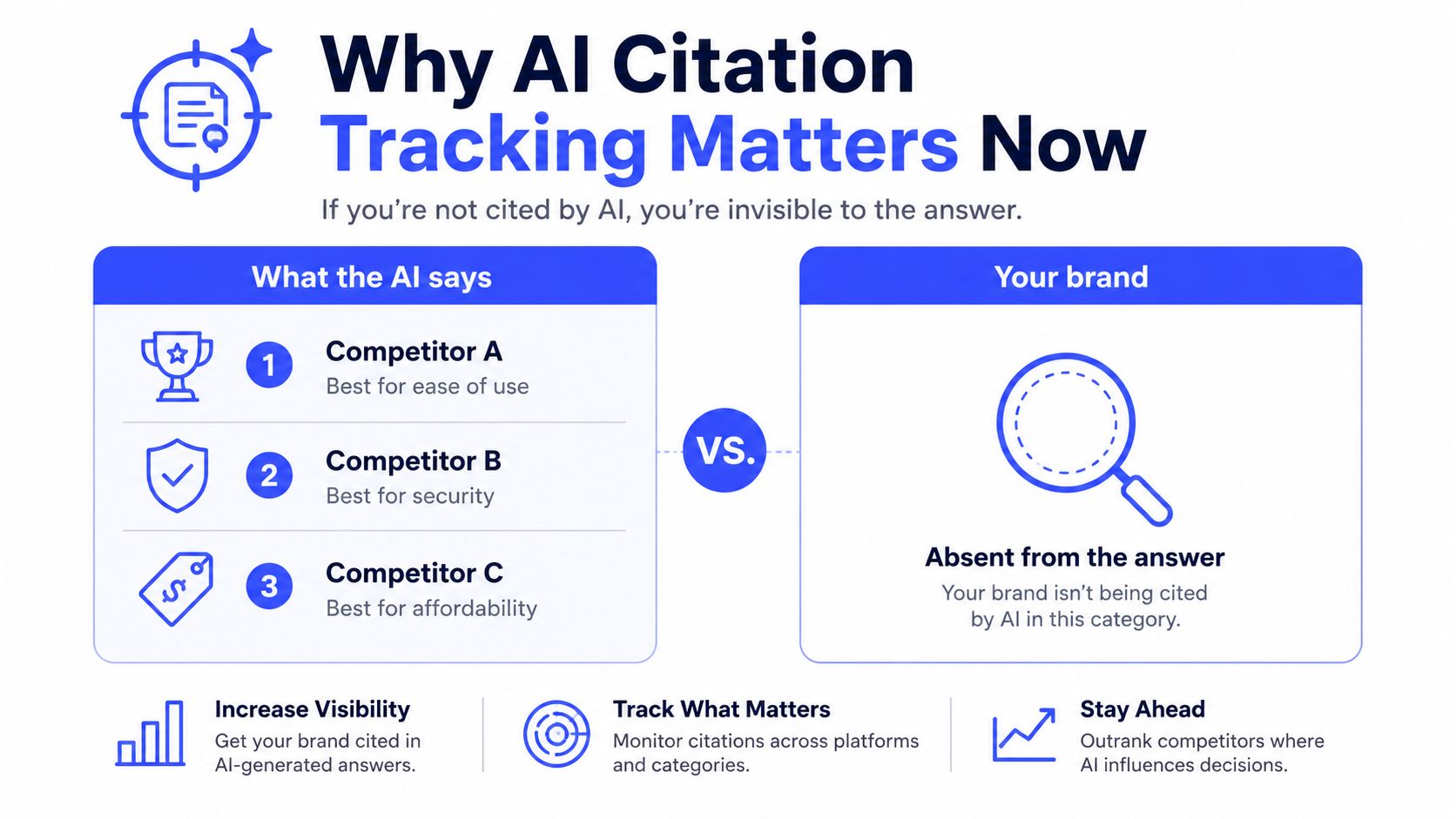
A marketing director runs a routine buyer prompt in ChatGPT: “What are the best project management platforms for a growing software company?” Three competitors appear in the answer, each supported by a source link. Her brand, despite holding strong organic rankings, is absent.
That discovery changes the team’s diagnostic question. They aren’t only asking whether their pages rank in Google. They’re asking whether assistants include, cite, recommend, or misrepresent the brand when buyers request a synthesized answer. AI citation tracking provides the operational layer for answering that question with repeatable prompts, stored responses, parsed citations, and actions tied to real sources.
Why AI Citation Tracking Matters Now
Traditional rank tracking measures a position in a list of links. AI citation tracking measures whether a brand becomes part of the answer itself, whether an assistant links to a page, names the company without a link, recommends it, or places it in a particular category.
That distinction matters because an answer can shape a buyer’s shortlist before the buyer visits a search result. A competitor may not have overtaken your rankings, but it may have become the source an assistant uses to explain the category, compare vendors, or recommend a solution.
Practical rule: Treat absence from a relevant AI answer as a visibility gap, even when your conventional rankings look healthy.
The measurement case is becoming more concrete. A 2026 study analyzed about 900,000 AI-generated answers across ChatGPT, Google AI Mode, Google Gemini, and Microsoft Copilot, tracking 4,210 cited webpages. The 25 most-cited human-written pages captured 23% of all webpage citations, while the 25 most-cited AI-written pages captured 4%. The leading human-written pages averaged 682 citations each, compared with 119 for the leading AI-written pages, meaning the former group earned about 5.7 times more citations per page according to the 2026 citation measurement study.
The operational implication is straightforward. Citation tracking isn’t just a vanity exercise about whether your logo appeared. It can reveal which pages assistants repeatedly select, which competitors displace you, and which external publications shape the answer.
Google showed an AI Overview on 49 of 50 results pages, or 98%, in another 2026 study, with a median of 11 sources per overview. ChatGPT with web search cited an average of 7.8 sources per answer when it searched, based on the AI citation behavior study. These results make the tracking surface richer than a binary “mentioned or not” metric. Teams can monitor source count, repeated URLs, assistant differences, and the position a brand occupies within an answer.
A useful operating model is to run the same buyer prompts regularly, preserve the raw output, and compare the result against a defined competitor set. The LiveMentions tracking documentation describes this kind of workflow, but the underlying principle applies whether the team uses a platform, scripts, or a spreadsheet: a single manual answer is an observation, not a trend.
Building a Prompt Library That Reflects Real Buyers
A prompt library should mirror how people ask for help, not how an SEO tool exports keywords. Buyers add context, constraints, opinions, job titles, industries, and regions. Those details can change which sources an assistant retrieves and how it frames a recommendation.
Start by grouping prompts into four intent buckets:
- Problem-aware: Questions such as “Why is our software implementation taking so long?” reveal the pain and the language buyers use before they know which solution category to consider.
- Solution-aware: “What are the best tools for managing distributed product teams?” tests whether your brand enters the category.
- Comparison: “How does Product A compare with Product B for regulated companies?” exposes competitive positioning and missing proof points.
- Validation: “What do users say about Product A after implementation?” tests reputation, reviews, customer evidence, and cautionary narratives.
Build several natural variations inside each bucket. Vary the persona, industry, company size, use case, and region. A procurement leader at a healthcare company may ask a different question from a founder at a software startup, even when both are evaluating the same product category.
A practical prompt matrix
The matrix below uses one project management SaaS topic to show how intent changes the measurement objective.
| Intent Stage | Sample Prompt | What It Reveals |
|---|---|---|
| Problem-aware | “Why do cross-functional software teams lose visibility into project dependencies?” | Whether the brand is associated with the problem and its underlying causes |
| Solution-aware | “What project management tools work well for distributed software teams?” | Category inclusion, cited competitors, and the sources shaping recommendations |
| Comparison | “Which is better for a growing software company, Product A or Product B?” | Relative positioning, product strengths, weaknesses, and co-citations |
| Validation | “What do customers commonly praise or criticize about Product A?” | Review evidence, sentiment, risk framing, and recurring objections |
Write prompts as complete questions. Stripped phrases such as “project management SaaS distributed teams” may be useful for search research, but they don't reproduce the conversational context of an assistant interaction.
The prompt-writing guidance for useful tracking questions is a useful reference for quality control. In practice, every prompt record should also include an owner, intent label, persona, market, priority, and date added.
Version the library
Prompt libraries decay when products, competitors, and buyer language change. Store the original wording, create a new version when the intent changes, and keep retired prompts available for historical comparison rather than replacing them without record.
Refresh prompts after meaningful product launches, pricing changes, acquisitions, new regulations, or major category shifts. A quarterly review provides a sensible governance rhythm, while high-priority commercial prompts deserve attention whenever sales and customer research reveal new language.
Automating Daily Runs Across AI Assistants
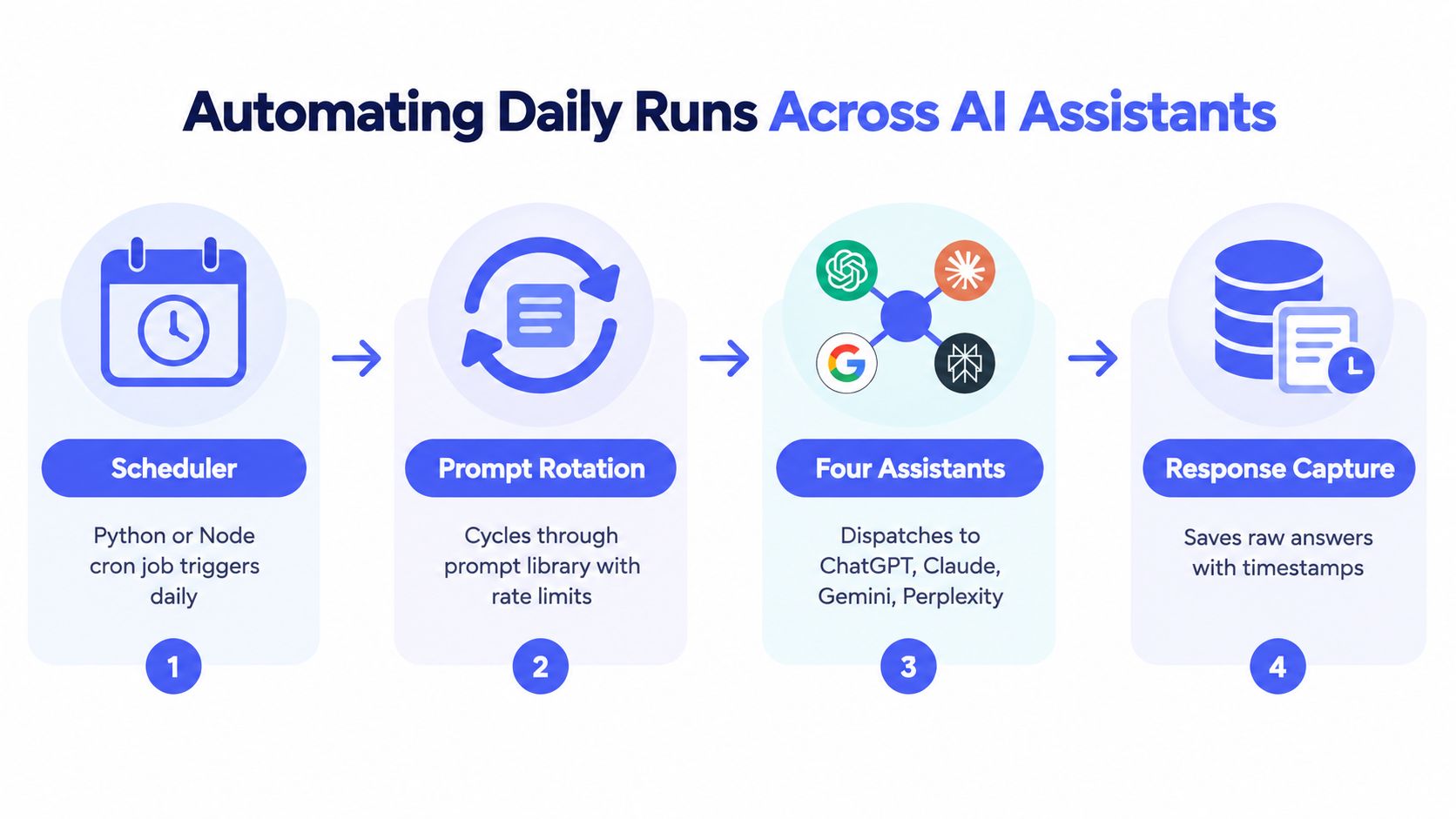
Automation starts with orchestration, not a dashboard. A small service can load active prompts, attach metadata, send them to supported assistant endpoints, capture the results, and write each run to storage. Python and Node are both practical choices because they handle HTTP requests, queues, JSON parsing, and scheduled jobs without a large engineering surface.
Use APIs where the assistant makes them available and permitted for your use case. For assistants without a suitable public endpoint, browser automation may be possible, but it introduces fragility, authentication concerns, interface changes, and terms-of-use constraints. A workflow that depends on a browser button is harder to audit than one with an explicit request and response record.
The run sequence
A reliable daily job follows a predictable path:
- Load the prompt set. Select active prompts by market, intent, priority, and assistant.
- Dispatch with controls. Rotate requests, respect rate limits, retry temporary failures, and avoid sending duplicate requests simultaneously.
- Capture the response. Save the complete answer, visible citations, metadata, and any refusal or tool-use state.
- Queue parsing. Separate collection from analysis so a parser failure doesn't erase the original answer.
- Record the outcome. Mark success, timeout, refusal, blocked request, malformed response, or incomplete citation capture.
Stagger scheduled jobs rather than firing every assistant at once. Cron, a CI workflow, or a managed scheduler can trigger separate queues, while a run ledger prevents accidental double-counting.
Before measuring trends, log the prompt text, assistant, model name, model version when available, timestamp, region, run ID, and raw response text. Also record whether web search was enabled, because a response generated without retrieval isn't directly comparable with one that includes live sources.
A run that succeeds technically can still produce unusable data. The assistant may change its response between runs, omit links, return a refusal, or provide a citation that doesn't resolve. Store these states explicitly instead of treating every non-empty response as valid.
The automation concept is also illustrated in this workflow video.
Consistency matters more than apparent sophistication. If the team changes the prompt wording, assistant settings, region, or parsing rules without recording the change, a later visibility shift may reflect instrumentation drift rather than a real change in how assistants describe the brand.
Parsing Citations, Mentions, and Framing
A raw answer contains several different signals. A URL alone doesn't tell you whether the assistant recommended the brand, mentioned it neutrally, or cited it as a cautionary example. The parser should preserve the answer first, then attach structured objects to the exact text spans where each signal appears.
Use four primary classifications:
| Citation Type | Detection Signal | Example | Recommended Weight |
|---|---|---|---|
| Link citation | Markdown link, footnote URL, source chip text, or resolved URL | Company page |
Useful evidence of source selection, but context is required |
| Brand mention | Product, company, domain, or known alias appears without a linked source | “Teams often consider Product A” | Moderate, especially when repeated in relevant answers |
| Recommendation | Imperative or evaluative language actively directs the buyer toward the brand | “Product A is a strong choice for distributed teams” | High, because it affects the decision itself |
| Framing | Descriptive language assigns a role, segment, strength, weakness, or risk | “Best suited to larger organizations” | High, because positioning changes buyer interpretation |
Combine deterministic and semantic detection
Regular expressions handle obvious URL formats, Markdown links, numbered footnotes, and common domain variants. Domain normalization should remove tracking parameters, resolve redirects where possible, and map subdomains to a known entity record.
Regex alone misses paraphrases, aliases, punctuation changes, and brand references that appear only in a recommendation sentence. An LLM classifier or embedding-assisted matcher can identify those cases, but it must return the matched text, classification, confidence, and reason. Never allow a classifier to overwrite the raw answer.
A representative audit log might contain a Markdown citation block, a shortened or partial URL, and two competitors mentioned in the same paragraph. The parser should retain the original token, normalized URL, surrounding sentence, character position, paragraph position, and co-mentioned entities. If a source appears in a footnote but the answer never uses its claim, that distinction belongs in the record.
The sentiment and framing documentation covers the distinction between presence and positioning. The practical scoring principle is to give more importance to recommendation and framing than to a bare URL match. A linked page in an appendix may generate little influence, while a product described as the right fit for a buyer’s situation can materially shape the shortlist.
Audit rule: A citation object isn’t complete until it includes the URL, the supported text, the surrounding context, and the role the brand plays in the answer.
Storing Full Answers for Historical Analysis
The minimum useful record contains more than a URL and a yes-or-no field. Store the full response text, exact triggering prompt, assistant name, model information, timestamp, region, run ID, retrieval state, and parsed citation objects.
A truncated answer destroys context. Months later, the team may need to determine whether the brand appeared in the opening explanation, a comparison table, a warning, or the final recommendation. URL-only storage can’t answer that question.
A workable storage model
A relational database works well for structured analysis. Keep separate entities for:
- Prompts: Wording, intent, persona, market, version, status, and owner.
- Runs: Prompt ID, assistant, model, timestamp, region, status, and configuration.
- Responses: Full text, raw payload location, answer length, refusal state, and parser version.
- Citations: Original URL, normalized URL, domain, span location, citation type, claim text, and verification state.
- Entities: Brand, product, competitor, expert, and alias mappings.
- Framing events: Position, sentiment, recommendation state, and surrounding descriptors.
Object storage such as S3 or R2 is appropriate for raw responses and payloads. A lightweight index table can link prompt IDs to response IDs, while relational tables hold the fields analysts query most often. This split protects the original evidence without forcing every report to scan large text blobs.
Keep parser versions and model versions alongside every result. If a new classifier changes “passing mention” into “recommendation,” the historical record should show which parser produced each label. Retention should reflect the decisions the team wants to make. If the purpose is trend analysis, deleting older raw responses removes the ability to audit apparent gains and losses.
Flag unresolved or suspicious sources rather than accepting them without a trace. Useful states include reachable, unreachable, redirected, irrelevant, unsupported, malformed, and unverified. That allows quality review to remain separate from visibility measurement.
Turning Citation Data Into Outreach That Works
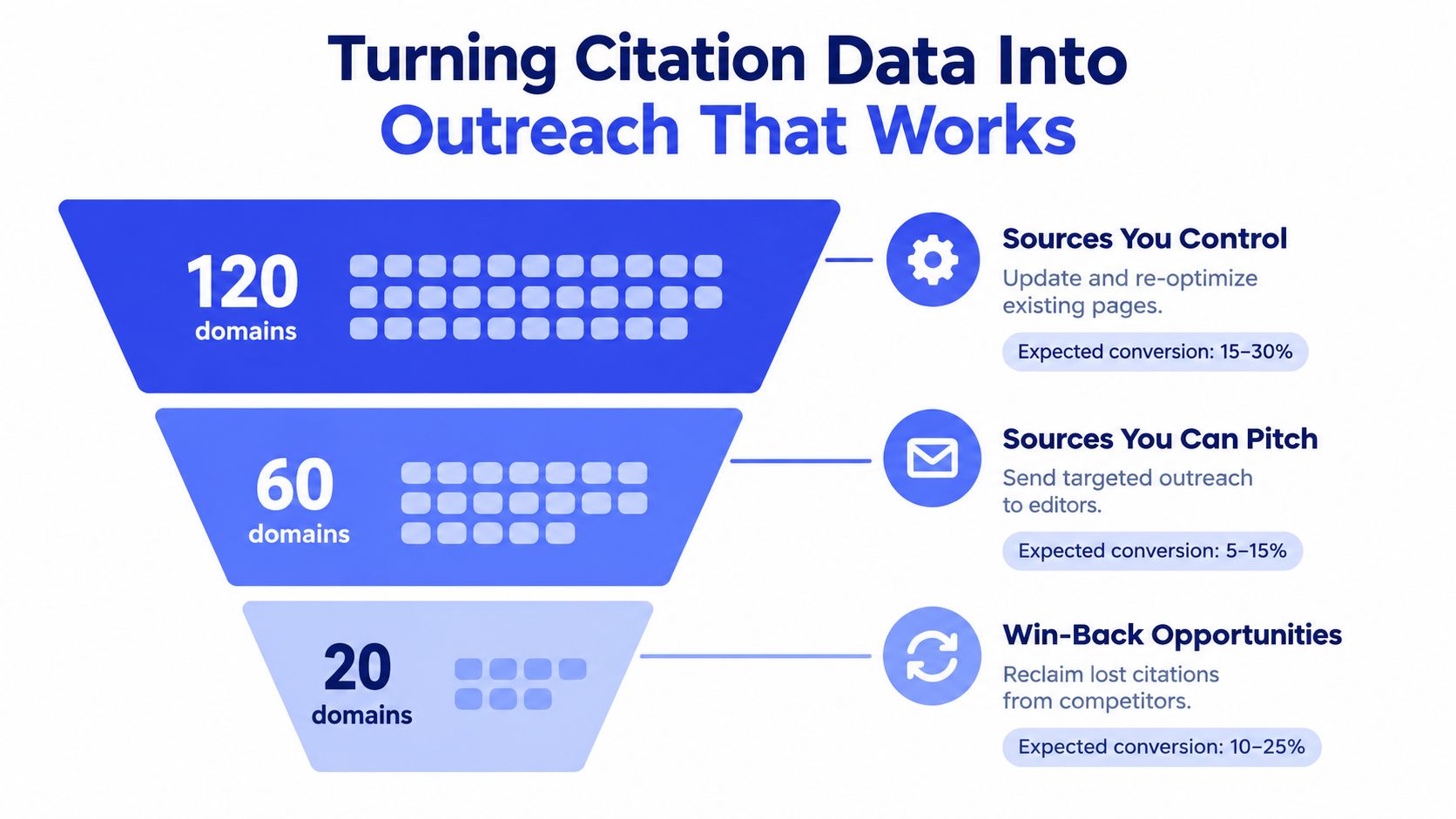
Citation intelligence becomes valuable when it changes who the team contacts and what it asks them to change. Start by sorting cited sources into three operational groups.
Sources you control include your own product pages, research, documentation, and comparison content. Update these first when the parser shows that assistants cite an outdated description, miss a key use case, or place the brand in the wrong category. Make the page easier to quote with clear definitions, current evidence, descriptive headings, and precise product language.
Sources you can pitch include industry publications, expert roundups, podcasts, research partners, and editorial sites. Lead with a specific gap from the answer, not a generic request for exposure. A subject line such as “Updated evidence for your distributed team software guide” is stronger than “Partnership opportunity,” provided the outreach offers a verifiable correction, expert contribution, or valuable original material.
Aggregators and directories deserve a different motion. A comparison site, review page, or category list may influence several answers at once. Ask the editor to correct a product description, add a missing capability, or distinguish your product from a similarly named competitor. Keep the request narrow and include the exact page, proposed wording, and supporting evidence.
Prioritize by frequency and framing
Build a simple matrix with citation frequency on one axis and framing strength on the other.
- Frequent citation with strong positive framing is a protect-and-maintain account.
- Frequent citation with weak or inaccurate framing is an update priority.
- Rare citation with strong framing is a promising source to strengthen.
- Rare citation with negative or confused framing needs evidence, clarification, or reputation work before amplification.
This prevents the team from chasing every domain that appears once. A source that repeatedly shapes buyer language may deserve attention even if it sends little directly attributable traffic.
A practical thirty-day rhythm keeps the work moving. During the first week, audit priority prompts and group the influential sources. During the second, update controlled pages and send targeted pitches. During the third, follow up with editors and validate whether corrections went live. During the fourth, rerun the same prompts, inspect new framing, and record which sources changed.
Outreach works best when the request is anchored to a visible answer problem, not an abstract promise of brand awareness.
Pitfalls and Gaps in Citation Tracking
The first mistake is treating every returned link as a win. A footnote citation, a neutral mention, a recommendation, and a warning can all produce the same binary “present” value in a weak dashboard. That flattening hides the difference between being used as evidence and being positioned as a poor choice.
Cross-engine divergence creates another blind spot. One 2026 study found that only 10.2% of cited URLs appeared on more than one engine for the same prompt, as reported in the cross-engine citation research. A brand that monitors only one assistant can mistake local strength for broad visibility.
Citation quality also requires claim-level verification. A 2026 benchmark found that the strongest frontier models maintained link validity above 94% and relevance above 80%, while factual accuracy ranged from 39% to 77%, according to the source attribution benchmark. A working link can still fail to support the sentence attached to it.
A separate framework found that an automated evaluator matched human expert judgments 79.3% of the time. On a random set of 300 questions, GPT-4o with retrieval produced 100% citation URL validity, but only 75.7% statement-level support and 38.4% response-level support, as documented in the citation verification framework. Your pipeline should therefore score URL reachability, claim support, and whole-answer support separately.
Finally, don’t assume citations persist. One longitudinal evidence base reported URL-level retention of only 10.6% over four weeks, and the citation trust and persistence research also found that users can trust an answer more when citations are present even if those citations are incorrect or hallucinated.
Run multiple assistants, preserve full answers, classify framing, verify claims, and track durability. Raw citation count is a useful starting signal, but it isn’t a verdict on authority, trust, or business impact.
LiveMentions runs buyer-style prompts across ChatGPT, Claude, Gemini, and Perplexity, captures full answers and cited sources, and tracks brand presence, position, and framing over time. Use LiveMentions to turn citation monitoring into a repeatable audit and outreach workflow.
Ready to see your own AI visibility?
Start Free Trial
Shahin Salehin
I’m Shahin, founder of LiveMentions and a software product builder with years of experience building WordPress plugins and tools for real businesses. My work has given me a practical perspective on product development, search, content, and how businesses build visibility online. With LiveMentions, I’m now focused on AI search and helping brands understand how they are represented across AI-generated answers. I write about AI brand visibility, AI search, and practical strategies based on research, experimentation, and what I learn from building in this space.
Articles: 7