
GEO vs SEO vs AEO is a question about what you count. SEO counts clicks and positions in search results. AEO counts whether an answer engine picks your passage as the answer. GEO counts how often, and how favorably, your brand appears inside AI-generated responses. The three terms overlap, so this guide defines each once, then compares the numbers, the tools and the order in which to work on them.
GEO vs SEO vs AEO: what does each term mean?
SEO is search engine optimization. Google's SEO Starter Guide describes it as helping search engines understand your content and helping people find your site through a search engine.
GEO is generative engine optimization. The term comes from a 2023 research paper, GEO: Generative Engine Optimization, by Pranjal Aggarwal and five co-authors. They define it as a black-box framework that helps creators increase their content's visibility in generative engine responses, and they define visibility metrics to go with it.
AEO is answer engine optimization. It has no single owner and no standard. One industry glossary notes that AEO, GEO and "AI SEO" are used largely interchangeably, and that some practitioners draw a loose line: AEO aims at direct answers such as featured snippets, GEO aims at being cited inside AI-written prose. This guide uses that loose line, because it separates the measurements cleanly.
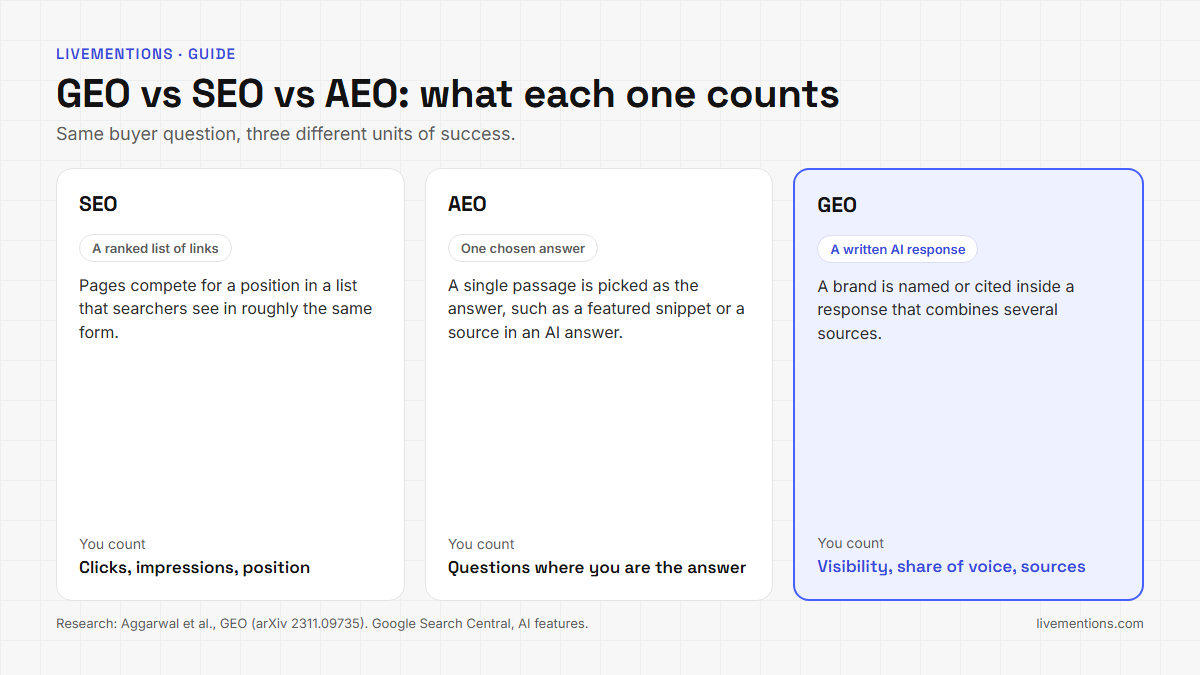
| Term | Where the work lands | Unit of success |
|---|---|---|
| SEO | A list of ranked links | A click from a result |
| AEO | A single answer or answer box | Your passage chosen as the answer |
| GEO | A written AI response | Your brand named or cited in the response |
What does SEO measure?
SEO measures how a page performs in a ranked list. Search Console's Performance report shows four numbers:
- Clicks: how often people reached your site from Google Search.
- Impressions: how many times your site appeared in Search results.
- CTR: clicks divided by impressions.
- Average position: the average position of the topmost result from your site.
These numbers describe a list that every searcher sees in roughly the same form. A position of 4 means the same thing to everyone who saw it. That shared, stable list is what makes SEO the easiest of the three to measure, and it is the baseline for the other two.
Google also says that sites appearing in its AI features are included in the overall search traffic in Search Console, reported under the Web search type. The SEO report therefore still covers the Google side of AI search.
What does AEO measure?
AEO measures whether your passage is the answer. The unit is one question and one answer, so the measurement is a yes or no per question, not an average position.
Google's featured snippets documentation shows why a yes or no is the honest unit. Asked how to mark a page as a featured snippet, the page answers "You can't." Google's systems decide whether a page makes a good snippet. You can limit snippets, but you cannot request one.
So an AEO check is a fixed list of questions, repeated over time:
- Write the 20 questions your buyers type.
- For each one, look at the answer box or the AI answer and note whose passage fills it.
- Record whether your page is the source, and repeat on a schedule.
The count of questions where your passage wins is your AEO number. It is simple, and it needs no special software, which is why it suits a spreadsheet.
What does GEO measure?
GEO measures how a brand appears across AI-written responses. The research paper explains why a ranking metric does not fit: a generative engine combines several sources into one response, so visibility depends on factors such as the length, uniqueness and presentation of the cited material. The authors propose three impression metrics:
- Word Count: the share of the response's words that sit in sentences citing your source.
- Position-Adjusted Word Count: the same share, weighted so that sources cited early count more.
- Subjective Impression: a language-model score across seven facets, including relevance, influence and likelihood of a click.
Those are research metrics. In practice a brand needs numbers it can read on a dashboard and compare with rivals. LiveMentions is an AI brand visibility platform. It tracks how often, and how favourably, a brand appears in answers from ChatGPT, Claude, Gemini and Perplexity, compares it with competitors, shows which sources the AI cites, and suggests ways to improve (the Optimize feature). Its dashboard metrics are defined like this:
- Visibility Score: the average, across tracked prompts, of how strongly your brand showed up in each answer.
- Share of Voice: your percentage of all brand mentions in an answer, counting you and every competitor.
- Position: your average rank among brands named, where 1 is the top brand.
- Sentiment: how favorably answers frame you: Positive, Neutral or Negative.
- Used as a Source: the percentage of links in answers that point to your own site.
A mention and a citation are different events, which is why the last metric sits apart. The guide to what AI brand visibility is covers the difference in detail.
Where do SEO vs AEO overlap, and where do they split?
SEO vs AEO is less of a contest than the names suggest. Google's page on AI features and your website is blunt: there are no additional requirements to appear in AI Overviews or AI Mode, and the best practices for SEO remain relevant. It adds that no special schema.org markup and no new machine-readable or AI text files are needed. The terms GEO and AEO do not appear on that page.
That makes most AEO work ordinary SEO work applied to a single passage: crawlable pages, text that states the answer plainly, headings that match the question, structured data that matches the visible text. The split is the unit and the click. In SEO, success is a visit. In AEO and GEO, success can be a name inside an answer with no visit at all, so the click-based report cannot see it.
The same page also warns that serving is never guaranteed, and the research paper adds a limit of its own: the authors tested two generative engines and did not evaluate how their methods affect traditional rankings. A tactic that helps in an AI response is not proven to help a Google ranking, and the reverse holds too. Measure each layer separately. Each engine also documents its own crawlers and search behavior; see what differs by engine.
How do the three sets of numbers compare?
| Metric | Term | Question it answers | Where you read it |
|---|---|---|---|
| Clicks and CTR | SEO | Did searchers reach the site? | Search Console Performance report |
| Impressions | SEO | How often did the site appear in results? | Search Console Performance report |
| Average position | SEO | How high is the topmost result? | Search Console Performance report |
| Answers won | AEO | On how many questions is your passage the answer? | A fixed question list, checked by hand |
| Visibility Score | GEO | How strongly does the brand show up across tracked prompts? | LiveMentions |
| Share of Voice | GEO | What share of brand mentions is yours? | LiveMentions |
| Position (in answers) | GEO | Where do you rank among brands named? | LiveMentions |
| Sentiment | GEO | How favorably is the brand framed? | LiveMentions |
| Used as a Source | GEO | How many cited links point to your site? | LiveMentions |
The two "position" numbers are not the same measurement. Average position in Search Console is about a link in a list. Position in LiveMentions is about the order in which brands are named inside an answer. Never put them in the same chart.
One question, three readings
The example below uses made-up numbers for a made-up brand, Northwind Invoicing, to show how the three lenses can disagree about the same buyer question. Every figure is illustrative.
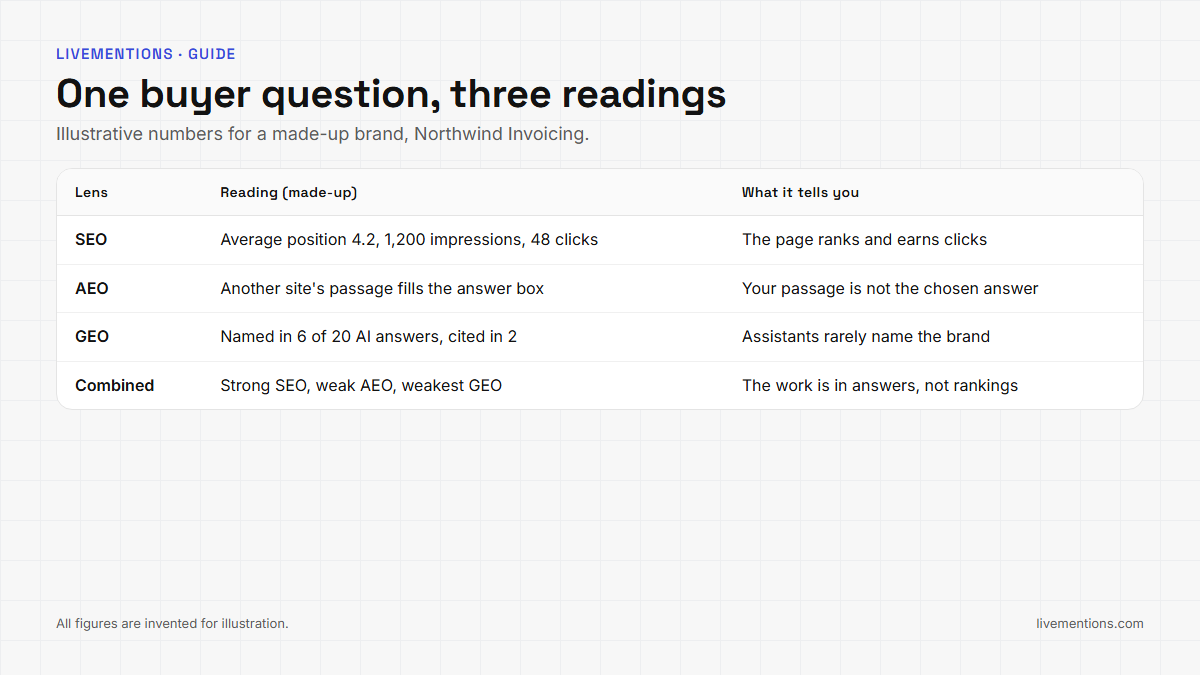
The SEO reading is healthy: the page sits near the top of the list and earns clicks. The AEO reading is a loss, because another site's passage fills the answer box. The GEO reading is the weakest: the brand is named in 6 of 20 collected AI answers and cited in 2. A report built only on rankings would call this question a success. A report built on all three shows exactly where the work is.
Which should you work on first?
The order depends on what the numbers show, not on which term is newer:
- If key pages are not indexed or not crawlable, start with SEO. Every other layer depends on being readable. This includes the AI crawlers: Optimize's Technical access pillar checks robots.txt rules, the sitemap, llms.txt and content that depends on JavaScript. Google says it needs no special files for its own AI features, so treat llms.txt as a separate question from Google visibility.
- If you rank well but assistants name rivals, start with GEO measurement. You need a baseline of Visibility Score, Share of Voice and cited sources before you can choose a fix. The Optimize feature turns those gaps into ranked actions across seven pillars.
- If your content already answers questions in plain words, add the AEO check. It costs a spreadsheet and an hour a month.
Teams that already run SEO reporting add the other two layers beside it. The SEO professionals page shows how the GEO layer fits into that work. For the wider picture of how ranking and citation interact, see the analysis of AI Overview SEO and the guide to LLM optimization.
What belongs on a monthly GEO vs SEO vs AEO scorecard?
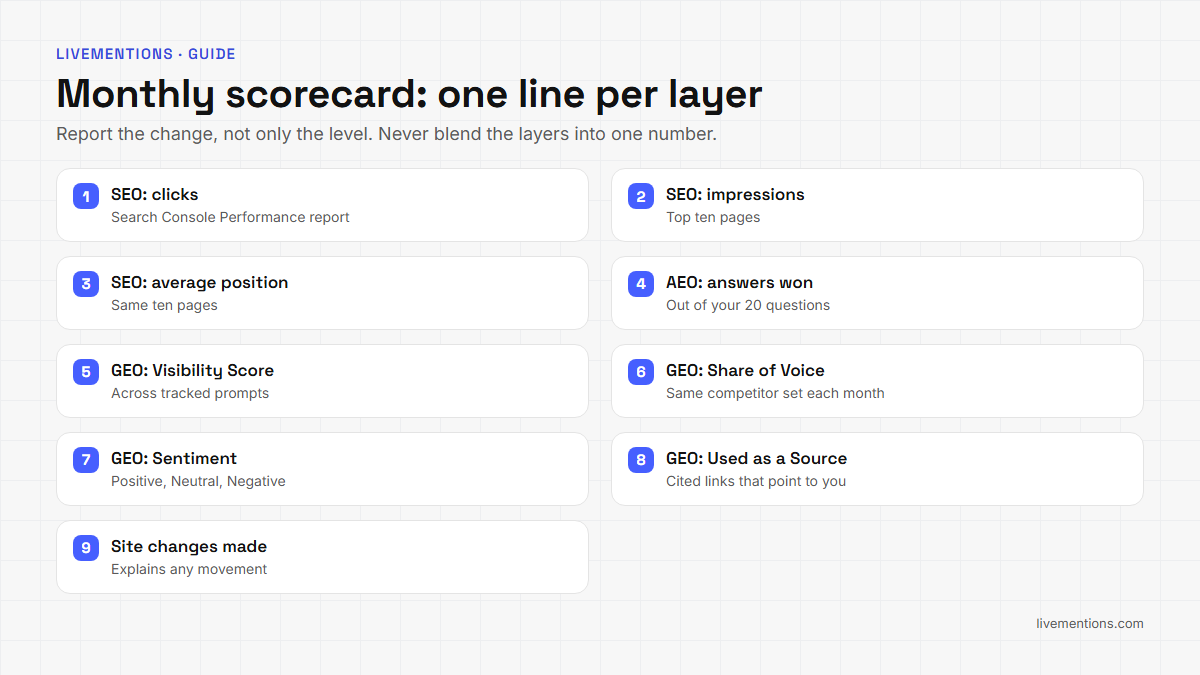
Keep one line per layer and report change, not only the level:
- SEO: clicks, impressions and average position for your ten most important pages.
- AEO: answers won out of the question list, and which questions moved.
- GEO: Visibility Score, Share of Voice, Sentiment and Used as a Source, with the competitor set unchanged from month to month.
- Note anything that changed on the site: a rewritten page, a new robots.txt rule, a new listing. Without it, a movement has no explanation.
Do not merge the three layers into one blended number. They count different things, and a blend hides which layer moved.
Frequently asked questions
Is GEO the same as AEO?
Not by any standard definition. The terms are often used interchangeably, but a common distinction is that AEO targets a single chosen answer, such as a featured snippet, while GEO targets visibility inside AI-generated responses. Because no standard exists, state which definition a report uses.
Does GEO replace SEO?
No. Google says the best practices for SEO remain relevant for its AI features, and Search Console still reports the search traffic that results. In GEO vs SEO vs AEO, the three are layers of one measurement stack, and GEO adds the layer for answers that SEO reports cannot see.
Do I need special markup or an llms.txt file for AEO or GEO?
For Google's AI features, Google states that no special markup, AI text files or machine-readable files are required. Neither Google page used for this guide recommends llms.txt. Whether other assistants read such files is a separate question to test, not to assume.
Can one tool measure SEO, AEO and GEO together?
Not as one number, and not honestly. Search Console covers SEO, a fixed question list covers AEO, and LiveMentions covers GEO across ChatGPT, Claude, Gemini and Perplexity. Keep the three reports side by side.
Start with the layer you cannot see today
Most teams already have the SEO numbers. The gap is the GEO layer: how often assistants name your brand, in what order, and with which sources. LiveMentions tracks your buyer prompts on ChatGPT, Claude, Gemini and Perplexity, keeps the full answers, and shows Visibility Score, Share of Voice, Position, Sentiment and cited sources in one place. Set up the prompt list this week, read the first baseline, and the GEO vs SEO vs AEO scorecard stops being a debate and becomes three numbers you can move.
Ready to see your own AI visibility?
Start Free Trial
Shahin Salehin
I’m Shahin, founder of LiveMentions and a software product builder with years of experience building WordPress plugins and tools for real businesses. My work has given me a practical perspective on product development, search, content, and how businesses build visibility online. With LiveMentions, I’m now focused on AI search and helping brands understand how they are represented across AI-generated answers. I write about AI brand visibility, AI search, and practical strategies based on research, experimentation, and what I learn from building in this space.
Articles: 18