
AI brand mention detection is the process of finding where an AI answer names your brand and classifying how it does so: as a passing mention, as a cited source, or as a recommendation. An answer can name you without linking to you, link to a page of yours without naming you, or tell the buyer to choose you. Those are three different outcomes, and one yes-or-no flag cannot tell them apart.
What is AI brand mention detection, and why is a yes-or-no answer not enough?
A flag that says "brand appeared" is the starting point of AI brand mention detection, not the finish. It tells you the name was found. It does not tell you whether the assistant offered it as the top pick, listed it beside four others, or used it as a warning.
LiveMentions treats the flag as the first of three layers. On every tracked prompt it records whether the brand appeared, how the answer framed it and which sources the answer cited. The Help center article on brand appearance defines the first layer in one line: brand appearance indicates whether the tracked brand was found in the AI response. The other two layers carry the meaning.
What is the difference between a mention, a citation and a recommendation?
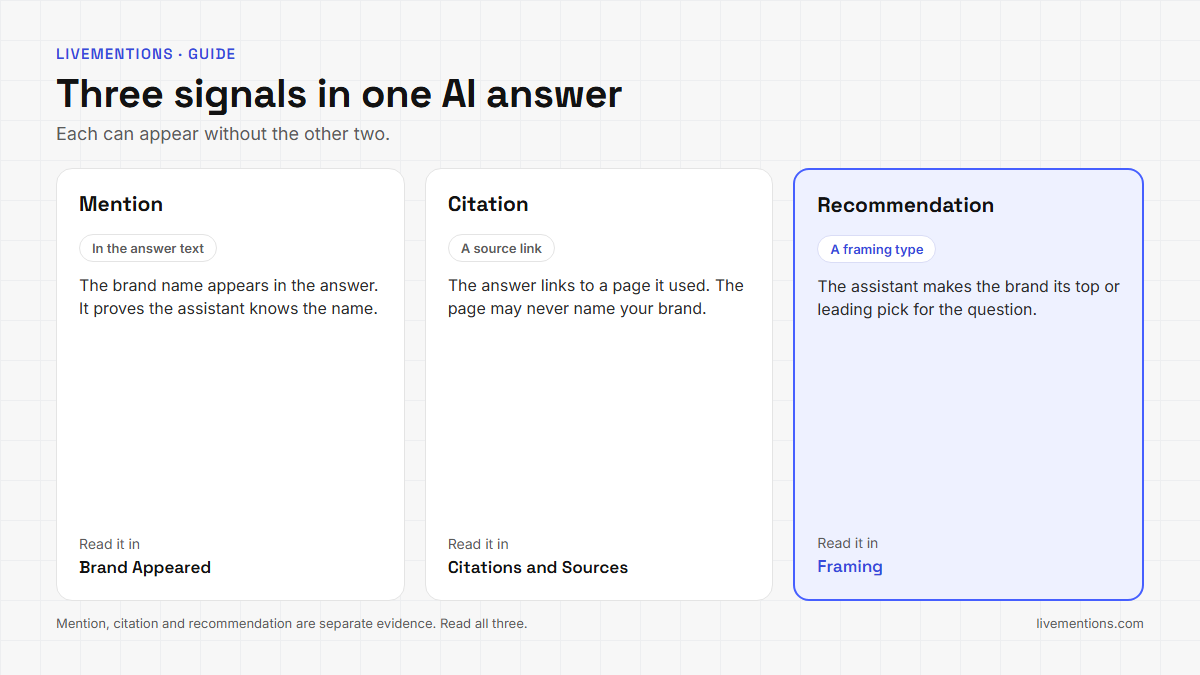
Each is a different kind of evidence, and each can occur without the other two.
| Signal | What it is | What it proves | Where you read it |
|---|---|---|---|
| Mention | Your brand name appears in the text of the answer | The assistant knows the name | Brand Appeared and the AI Answer on the prompt detail page |
| Citation | The answer links to a source page | The assistant used that page | The Citations table and the Sources page |
| Recommendation | The assistant presents your brand as its top pick | The assistant endorses you | Framing, as Primary Recommendation |
A citation belongs to a page, not to a brand. OpenAI's help article on web search says that responses using web search may include citations and that selecting one opens its source. The Perplexity help center says every answer includes numbered citations linking to the original sources. Neither promise says the cited page names you, and that gap is where the next section starts.
The older guide to what AI brand visibility means makes the same split from the other side: a citation is not necessarily a brand mention, and a brand can be mentioned without a link to its website.
How can a citation exist without mentioning your brand?
Easily, because an assistant cites pages for the facts they contain. A page about "how to measure AI visibility" can be cited in an answer that never names the company that published it, and a third-party list can be cited in an answer that names ten brands and not yours.
OpenAI's article tells readers to open a cited source and check that it supports the answer. Brand mention detection has to do the same thing, at scale, for the brand. The public changelog entry for 30 September 2026, titled Citation accuracy fix, describes the rule. A citation could be marked as mentioning your brand when the cited page never named it, and LiveMentions now checks the real cited page before it marks a mention.
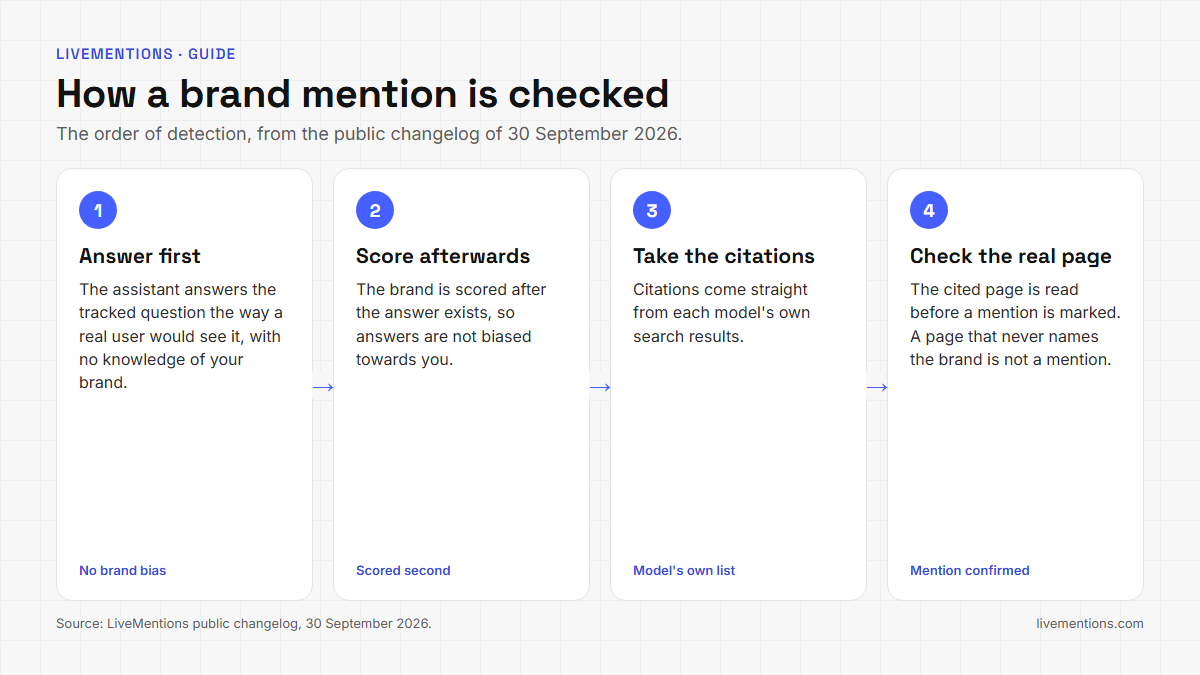
The order matters, and each step comes from what the changelog states:
- The answer is collected without brand bias. Another 30 September entry says the four tracked assistants answer your questions the way a real user would see them, with no knowledge of your brand.
- The brand is scored afterwards. That keeps the answers from leaning towards you.
- Citations come from the model's own search results, not from a guess about which pages it used.
- The real page is checked. A citation is marked as mentioning your brand only when the page actually does.
The same release added two stats to the Sources page, Mention Share and Brand Mentions, which show how often AI answers cite pages that actually mention your brand. That is the citation layer in one number: how often the pages assistants cite actually name you.
What does a citation check look like in practice?
The table below is an illustration with made-up pages. It shows why the check changes the reading of one answer.
| Cited page (illustrative) | Cited in the answer | Page names the brand | Counted as a brand mention |
|---|---|---|---|
| A buyer's guide on a review site | Yes | No | No |
| A forum thread about the category | Yes | Yes | Yes |
| The brand's own pricing page | Yes | Yes | Yes |
Without the check, all three rows would read as visibility. With it, one of the three is a page that helped the assistant answer and never helped the brand. The Citations table on the prompt detail page keeps the two apart with a Mentions column that reads Not mentioned for a cited page that does not name the brand.
What are the five framing types, and which one is a recommendation?
Framing is how the assistant positions the brand once it names it. The Docs page on sentiment and framing sorts each AI mention into one of five types:
| Framing type | What the answer did with the brand |
|---|---|
| Primary Recommendation | Made it the top or leading pick for the question |
| Viable Alternative | Listed it as one good option among several |
| Neutral Reference | Mentioned it factually, with no real endorsement either way |
| Mentioned in Passing | Brought it up briefly or without directly answering the question |
| Negative or Cautionary | Raised a concern, criticism or warning about it |
A recommendation is therefore one of the five framing types, and only the first. A brand can be mentioned in every answer and still never be recommended: all of its mentions sit in Neutral Reference or Mentioned in Passing.
Each framing type carries a weight in the overall sentiment score. Primary Recommendations count most positively, Negative or Cautionary mentions count most negatively, and the rest fall between. The weighted results average into an overall lean of Positive, Neutral or Negative.
The prompt detail page shows how the answers on a prompt are spread across the five types. The crop below pairs the summary strip with the Framing section from a LiveMentions demo project.
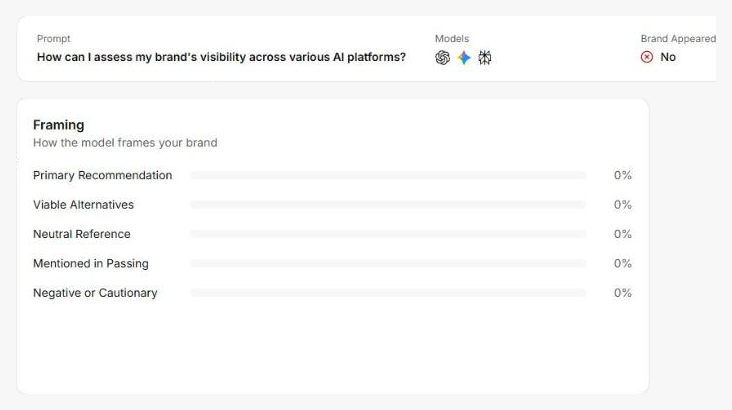
On this prompt the brand did not appear, so every bar is empty. The five labels are the same on every prompt (the chart shows Viable Alternative in the plural), and the percentages fill in as answers name the brand.
How do the three signals combine into one reading?
Read the signals together and each answer falls into a pattern with a next step. This grid is the article's own way of reading them, built from the three layers above.
| Named in the answer | Page cited | Framing | What it means | What to do |
|---|---|---|---|---|
| Yes | Yes, names you | Primary Recommendation | The strongest outcome | Protect the page and the wording |
| Yes | No | Viable Alternative | The assistant knows you but gives no link | Look for the source it relied on |
| Yes | Yes, but a page that does not name you | Neutral Reference | A third party carries the answer | Work on the sources, not the answer |
| No | Yes, your page | None | Your page is used and your name is not | Make the brand name unmistakable on the page |
| No | No | None | Absent | Check the gap against the sources assistants do cite |
The fourth row is the one a simple flag hides, and the one brand mention detection exists to surface. A cited page of yours that never names the brand is real evidence of influence and zero evidence of brand visibility.
Where do you read each signal in LiveMentions?
Every layer of brand mention detection is visible on the prompt detail page. Open any prompt. The Docs on prompts describe the prompt detail page in the order a reader needs:
- Summary strip: the prompt text, the tracked models, whether your brand appeared, the location and the status.
- AI Answer: the exact text the model returned the last time the prompt ran, so you read the real output and not only a score.
- Framing: how the answer positioned your brand.
- Brands: each competitor mentioned beside you, with position and visibility.
- Citations: every source link the answer included.
For the citation layer across all prompts, use the Sources page. Each citation is recorded as directly cited or just referenced, with its URL, the platform that used it and the date. The guide to AI citation tracking shows how citations are collected and parsed.
What should you do with each result of brand mention detection?
Brand mention detection pays off only when each result leads to an action. Match the action to the layer that failed:
- Not named at all: the problem is awareness. Look at which pages the assistant cites for the prompt and which of them omit you.
- Named, never recommended: the problem is positioning. Read the AI Answer and compare the wording assistants use with the claims on your own pages.
- Cited, not named: the problem is attribution. Put the brand name, product name and a plain description near the passage the assistant is quoting.
- Named with a cautionary framing: the problem is reputation. Read the exact wording and trace it to a source.
Frequently asked questions
What is the difference between a brand mention and a citation in AI answers?
A mention is your brand name appearing in the answer text. A citation is a link to a source page the answer used. A citation can come from a page that never names your brand, and a mention can arrive with no link at all.
Does a citation count as an AI brand mention?
Only when the cited page names the brand. In LiveMentions, brand mention detection checks the real cited page before it marks a mention, so a citation to a page that never names you is not counted as one.
Can an AI recommend a brand without citing it?
Yes. A recommendation is a framing type, Primary Recommendation, which describes how the answer treats the brand. Citations are a separate list of source links, and an answer can recommend a brand with no source links at all.
How many framing types does LiveMentions use?
Five: Primary Recommendation, Viable Alternative, Neutral Reference, Mentioned in Passing, and Negative or Cautionary. They roll up into an overall sentiment of Positive, Neutral or Negative.
Read the next answer as three signals
LiveMentions is an AI brand visibility platform. It tracks how often, and how favourably, a brand appears in answers from ChatGPT, Claude, Gemini and Perplexity, compares it with competitors, shows which sources the AI cites, and suggests ways to improve (the Optimize feature). Open one prompt in GEO Insights, read the AI Answer in full, then check the three layers in order: whether the brand appeared, how it was framed and whether the cited pages name it.
Ready to see your own AI visibility?
Start Free Trial
Shahin Salehin
I’m Shahin, founder of LiveMentions and a software product builder with years of experience building WordPress plugins and tools for real businesses. My work has given me a practical perspective on product development, search, content, and how businesses build visibility online. With LiveMentions, I’m now focused on AI search and helping brands understand how they are represented across AI-generated answers. I write about AI brand visibility, AI search, and practical strategies based on research, experimentation, and what I learn from building in this space.
Articles: 18