
Brand Context is the LiveMentions page that stores what is true about your brand, in your own words: who you are, what you offer, who you serve and which claims to make and avoid. LiveMentions uses it to write and check with your real facts. Brand Context is never added to the questions sent to AI engines, so every tracked answer stays an honest measurement.
That one rule is what makes brand context AI features safe to use next to a visibility tracker. The facts guide the writing, the drafts and the checks. They never steer the answers that ChatGPT, Claude, Gemini and Perplexity give about you. This guide explains what the page holds, where its text comes from, the five places it is used and what a finished fact sheet looks like.
What is Brand Context in LiveMentions?
Brand Context is a page in the LiveMentions sidebar where the platform keeps what it knows about your brand. You can read it at a glance and edit it line by line. When a project is created, LiveMentions AI reads your website and fills in what it can. Anything you write yourself keeps your exact wording.
Think of brand context AI as the fact sheet that a new writer, a new agency or an assistant would ask for on day one. Without it, any tool that drafts copy about your brand has to guess your founding year, your audience or your product names. With it, the tool starts from facts you approved.
The Brand Context Docs describe the page in the same terms used here. A short companion article in the Help Center, what Brand Context is, covers the basics in a few lines.
What does Brand Context hold?
The page is split into five sections. Each section is a card with its own fields, and each card shows whether it is partly filled, complete or missing context.
| Section | What it holds |
|---|---|
| Company overview | Title, description, overview, positioning, team, brand name, aliases and misspellings, a glossary of your terms, and your products with their web addresses |
| Offerings | What you are, your key features and your pricing, in your own words |
| ICP and audience | Who the product is for, plus audience segments with their pain points and questions |
| Positioning and strategy | Differentiators, proof points, claims to make, claims to avoid and tone of voice |
| Competitors | Your notes on each tracked competitor (the competitors themselves are managed on the Competitors page) |
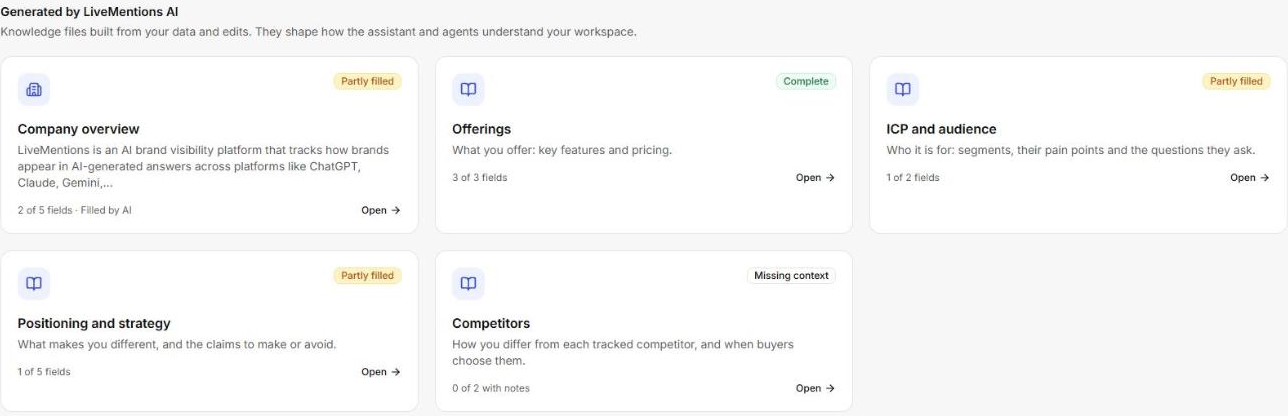
The status badges tell you where to spend time in brand context AI setup. A card marked Missing context has nothing for LiveMentions to work from, and an empty field offers an Add context button instead of an invented default.
Where does the text in Brand Context come from?
Every field is labelled with one of three sources, so you can always tell who wrote what:
- AI from your site: text LiveMentions AI wrote after reading your website.
- AI from your tracked answers: text LiveMentions AI took from the AI answers it tracks for your project.
- Written by you: text you typed or edited yourself.
Two rules protect your wording. First, you can edit any field and save it, and Reset to AI version brings back the AI-written text if you change your mind. Second, LiveMentions does not fill a field with an invented value: where it has nothing to go on, the field stays empty and says that context is missing.
The labels matter for trust in brand context AI. An AI-written line is a starting point to confirm, and a line marked Written by you is a fact you stand behind.
How does brand context AI use your facts?
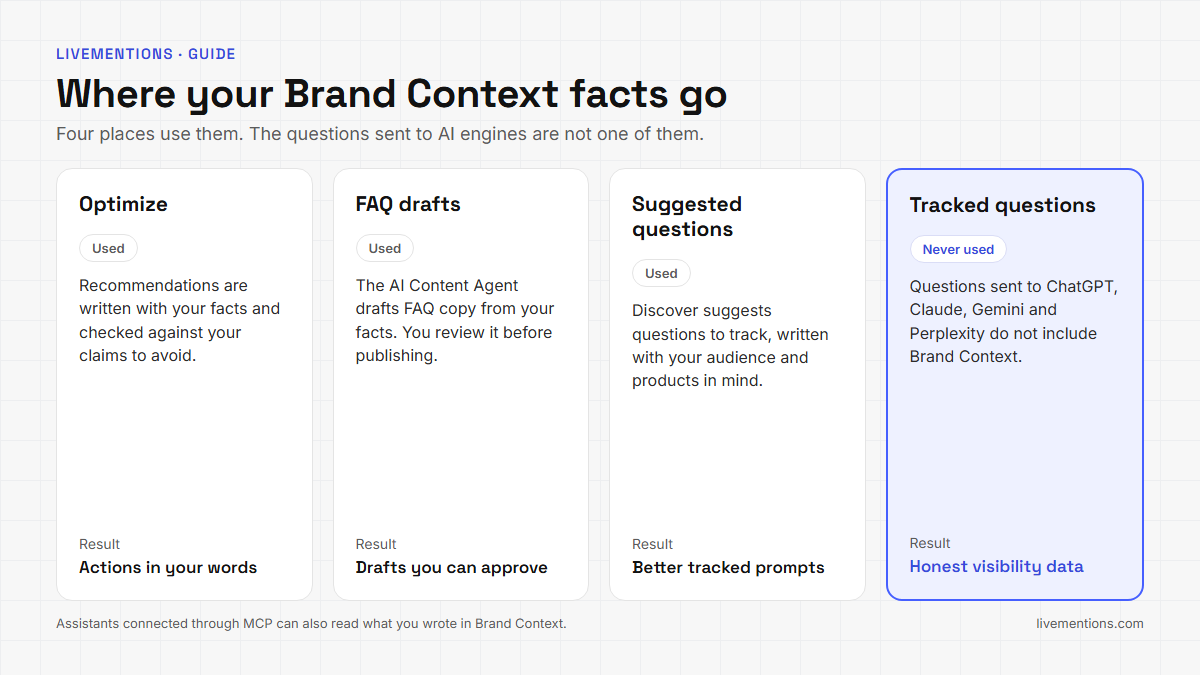
Saved facts are used in five places. The first four are writing and reading jobs. The fifth is a check.
| # | Where | What Brand Context does there |
|---|---|---|
| 1 | Optimize recommendations | Your facts shape the actions written for you |
| 2 | FAQ drafts | The AI Content Agent drafts FAQ copy from your facts, and you review it before publishing |
| 3 | Suggested questions to track | Discover shows suggested questions to track, written with your audience and products in mind |
| 4 | Assistants connected through MCP | A connected assistant can read what you wrote in Brand Context for a project |
| 5 | The AI accuracy check | Recent AI answers are compared with your facts, on paid plans |
Drafts are also checked against your claims to avoid, so a statement you ruled out does not slip into generated copy. The Optimize page explains how each finding becomes a ranked action and states that you review, edit and publish; nothing goes live on its own.
Why do your visibility numbers stay honest?
A visibility tracker works by asking AI engines the questions a buyer would ask and recording what they say. If your brand facts were added to those questions, the engines would repeat your own wording back to you. The score would then measure your input, not how AI describes you today.
LiveMentions keeps the two apart. The Brand Context page states it in one banner: your visibility numbers stay honest, because the tracked answers are generated without knowing your brand, and Brand Context never changes them. It is used to recognise your brand names, suggest the right prompts and write with your real facts.

This separation is why you can edit Brand Context freely. Adding a fact, correcting a product name or removing a claim changes the drafts and the checks. It does not change a single tracked answer.
What do claims to make and claims to avoid do?
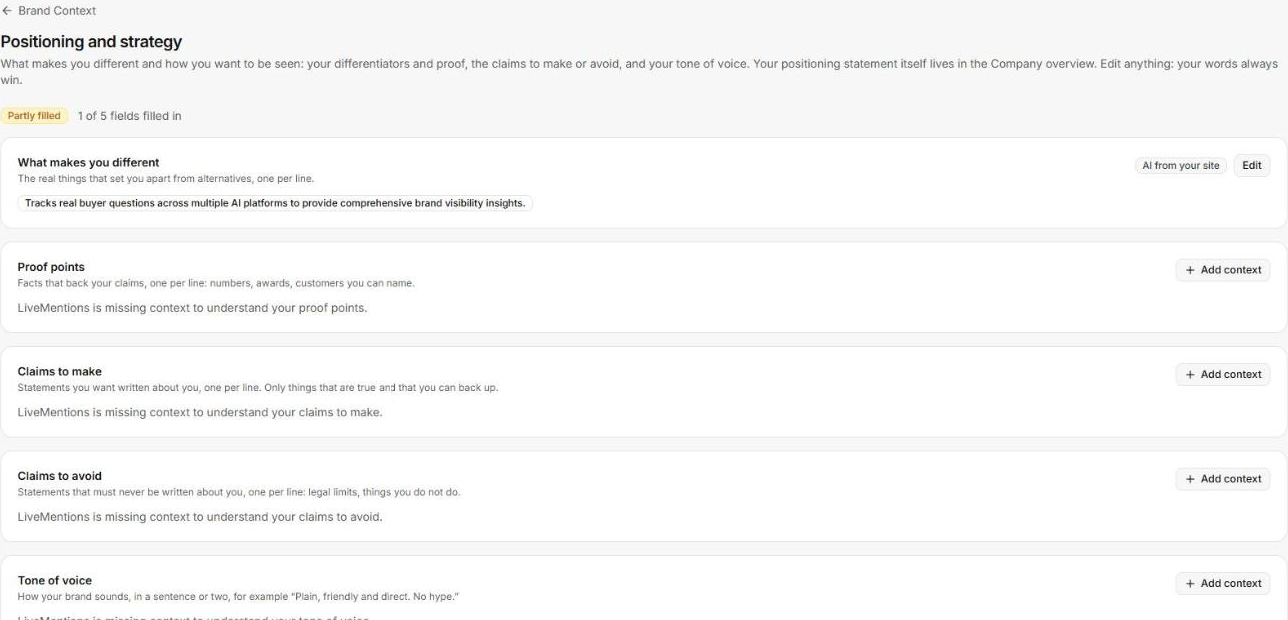
The Positioning and strategy section holds two lists that work like a style guide with a safety rail.
- Claims to make are statements you want written about you, one per line. The field asks for things that are true and that you can back up.
- Claims to avoid are statements that must never be written about you, such as legal limits or things you do not do.
The public Brand Context page gives two examples of claims to avoid: "Cheapest on the market" and "Works for everyone." Both are claims that are hard to prove and easy to regret. LiveMentions checks the writing it produces against the claims you list.
Aliases belong to the same idea. Other names or spellings people use for your brand sit under the Company overview, and LiveMentions counts them as your brand when it checks AI answers. A misspelling that an engine repeats is still your brand being named.
What does a Brand Context fact sheet look like?
A good brand context AI fact sheet is a list of short, checkable lines. The example below is invented. Brightwell Ledger is a made-up brand, and none of the entries is a benchmark or a real customer fact. It shows the level of detail that works: one plain fact per line.
| Field | Example entry |
|---|---|
| Brand name | Brightwell Ledger |
| Aliases and misspellings | Brightwell, Brightwel Ledger, BrightwellLedger |
| Description | Brightwell Ledger is invoicing software for small businesses. |
| Founding fact | Founded in 2021 |
| ICP and audience | Owners of small businesses with no finance team |
| Audience question | How do I send invoices without a spreadsheet? |
| Claims to make | Connects to the major banks; used by small businesses in any industry |
| Claims to avoid | Works for every business size; guaranteed to cut late payments |
Short lines are easy for a person to review and for a tool to reuse. A line such as "Founded in 2021" can be compared with an AI answer. A paragraph of marketing language cannot.
How does the AI accuracy check use Brand Context?
The AI accuracy check is a paid-plan feature that turns your saved facts into a test. In Optimize you open the AI accuracy card, choose Check now, and LiveMentions compares recent AI answers about your brand with the facts in your Offerings, Audience and Company overview.
It reports two kinds of finding:
- Contradiction: an answer conflicts with one of your facts, such as a different founding year or pricing model.
- Not covered: an answer makes a specific claim that none of your facts mention.
Each finding shows the engine and the exact words, and for a contradiction the fact it conflicts with. Open this fact takes you to the fact so you can correct it, and Dismiss removes a finding that is not a problem. If the card says Add some facts first, the check has nothing to compare against yet, which is another reason to fill the page in. The AI accuracy check Docs list the steps and the empty states.
What is the knowledge base for?
The page also links to a knowledge base, which holds your own material behind the fact sheet: files, pasted text, scraped pages and a crawl of your website. Adding material is part of the paid plans.
Where Brand Context holds short facts, the knowledge base holds the longer documents those facts come from, such as policies, product documents and help pages. The material is used by LiveMentions' writing and by connected assistants, which can read the passages that match a question. Like Brand Context, it is never added to the questions sent to AI engines. The knowledge base Docs explain what can be added and how.
Is Brand Context the same as Organization markup?
No. They describe a brand for different readers, and brand context AI is not a markup format. Organization markup is structured data on your own site. Google's Organization structured data guide explains how to add it to a home page or About page, lists recommended properties such as name, alternateName, description and sameAs, and states that there are no required properties. Schema.org defines the type as an organization such as a school, NGO, corporation or club, and defines alternateName as an alias for the item.
Brand Context is a private working document inside LiveMentions. It does not publish anything to your site and it does not change what search engines read.
The two do share a habit: write down who you are in plain, consistent facts. Google's page on AI features and your website says there is no special schema.org structured data you need to add to appear in AI Overviews or AI Mode. The facts on your pages still need to be accurate, and a fact sheet is the place to settle them before you publish them anywhere. The guide to what AI brand visibility is explains the mentions, citations and framing that the tracked answers show.
Frequently asked questions
What is brand context AI in LiveMentions?
Brand Context is the LiveMentions page that stores what is true about your brand, in your own words, covering company overview, offerings, audience, positioning and claims. LiveMentions uses it for drafts and checks, and it is never added to the questions sent to AI engines.
Do I have to fill in Brand Context myself?
No. LiveMentions AI reads your website when the project is created and fills in what it can, and each field shows whether it came from your site, your tracked answers or you. Writing and editing every field by hand is possible on every plan.
Will my edits be overwritten?
No. A line you write yourself keeps your exact wording, and Reset to AI version is there only if you want the AI-written text back.
Does Brand Context change my visibility score?
No. Tracked questions are sent to ChatGPT, Claude, Gemini and Perplexity without your Brand Context, so the answers reflect how AI describes your brand today.
Is Brand Context included on every plan?
Writing and editing Brand Context is available on every plan. The knowledge base and the AI accuracy check are on paid plans, and a 7-day free trial is available.
Write your facts once and let every draft use them
LiveMentions is an AI brand visibility platform. It tracks how often, and how favourably, a brand appears in answers from ChatGPT, Claude, Gemini and Perplexity, compares it with competitors, shows which sources the AI cites, and suggests ways to improve (the Optimize feature).
Open Brand Context for your project, read what AI took from your site, correct anything that is wrong and add the claims you want to make and avoid. A short pass on the page gives brand context AI a base to work from, and every later draft, suggested question and accuracy check a set of facts to work from.
Ready to see your own AI visibility?
Start Free Trial
Shahin Salehin
I’m Shahin, founder of LiveMentions and a software product builder with years of experience building WordPress plugins and tools for real businesses. My work has given me a practical perspective on product development, search, content, and how businesses build visibility online. With LiveMentions, I’m now focused on AI search and helping brands understand how they are represented across AI-generated answers. I write about AI brand visibility, AI search, and practical strategies based on research, experimentation, and what I learn from building in this space.
Articles: 18