
Your page can rank on Google and still never appear in a ChatGPT answer. Here is how to get cited by ChatGPT: make the page readable by OpenAI’s search crawler, then make it worth quoting. OpenAI documents the first part and says plainly that placement is not guaranteed. Most advice about the second part comes from vendors, not from OpenAI. This guide grades seven common tactics by how well the evidence supports them.
What does it mean to get cited by ChatGPT?
When ChatGPT searches the web to answer a question, its response may include citations that link to the pages it used. OpenAI’s help page says a citation can be opened to view its source, and that a Sources view lists cited sources and other relevant links.
A citation is not the same as a brand mention. A page can be cited without the brand being recommended, and a brand can be recommended without a link to its site. This guide is about citations: links to your pages inside ChatGPT answers.
Two things decide whether you appear. The first is eligibility: can OpenAI’s crawler read your page at all? The second is selection: among the pages it can read, which ones does ChatGPT choose? OpenAI explains eligibility. For selection it says only that ChatGPT ranks results using multiple factors and that placement is not guaranteed.
How to get cited by ChatGPT: how the seven tactics are graded
Every tactic below carries one of four grades. The grade tells you how much weight to give it.
| Grade | What it means |
|---|---|
| Documented by OpenAI | Stated on an OpenAI page that was opened and read for this guide |
| Supported by research | A published study points the same way, with its limits stated |
| Reasoned, not documented | Follows from how crawlers and search work; no primary source confirms the effect |
| Vendor claim, unverified | Repeated by marketing posts with no primary source found |
| # | Tactic | Grade | First step |
|---|---|---|---|
| 1 | Allow OAI-SearchBot | Documented by OpenAI | Check robots.txt and your CDN |
| 2 | Know what each OpenAI bot does | Documented by OpenAI | Write one rule per bot |
| 3 | Put the answer in the served HTML | Reasoned, not documented | View the page source |
| 4 | Answer first, then explain | Supported by research | Rewrite your first paragraph |
| 5 | Publish what only you can say | Reasoned, not documented | Add one original example |
| 6 | Earn mentions on trusted sources | Vendor claim, unverified | List the domains cited for your topic |
| 7 | Keep key pages current | Reasoned, not documented | Update pages that answer current questions |
1. Allow OAI-SearchBot (documented by OpenAI)
This is the only tactic that OpenAI states as a requirement. On its page about searching the web with ChatGPT, OpenAI says what makes a website eligible for inclusion. Allow OAI-SearchBot to crawl the site. Then confirm that your host or content delivery network allows traffic from OpenAI’s published searchbot IP addresses.
OpenAI’s crawler documentation adds two details. A site that blocks the crawler is kept out of ChatGPT search answers, although it may still appear as a navigational link. And a change to robots.txt can take about 24 hours to take effect for search results.
First step: open yourdomain.com/robots.txt and make sure nothing disallows OAI-SearchBot. A rule that explicitly allows it looks like this:
User-agent: OAI-SearchBot
Allow: /
Then check the firewall or CDN in front of your site. Bot protection that challenges unknown crawlers can block a crawler that robots.txt allows.
2. Know what each OpenAI bot does (documented by OpenAI)
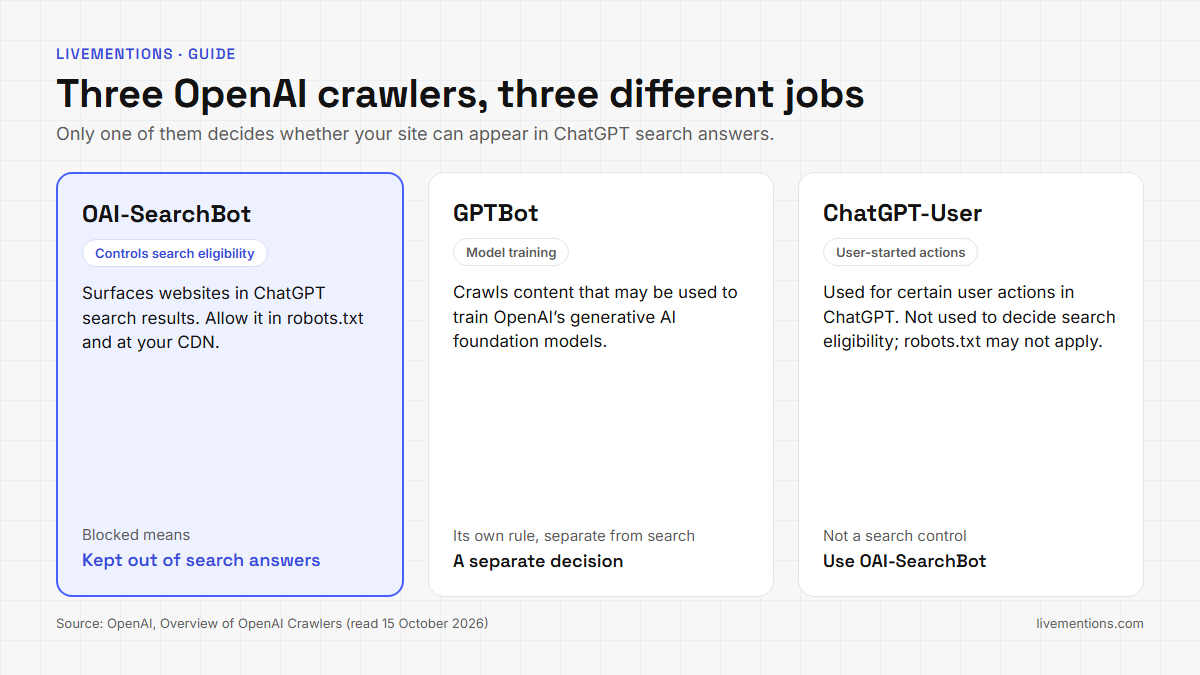
OpenAI lists separate crawlers with separate purposes:
- OAI-SearchBot surfaces websites in ChatGPT search results.
- GPTBot crawls content that may be used to train OpenAI’s generative AI foundation models.
- ChatGPT-User is used for certain user actions in ChatGPT. OpenAI states that it is not used to determine whether content may appear in search, and that because users start these visits, robots.txt rules may not apply.
Because they are separate user agents, a robots.txt rule for one is not a rule for the others. A site that wants to stay out of model training and still be eligible for search needs a rule for GPTBot and a different one for OAI-SearchBot. Decide each on its own merits.
First step: write one robots.txt group per bot and note, next to each, why it is allowed or blocked.
3. Put the answer in the served HTML (reasoned, not documented)
A crawler reads the HTML it is served. If the answer to a question only appears after a script runs in the browser, a crawler that does not run scripts never sees it. OpenAI’s crawler page does not say how OAI-SearchBot renders pages, so this tactic rests on reasoning, not on a statement from OpenAI.
First step: open the page, view the source (Ctrl+U or Cmd+Option+U) and search for the sentence that answers the main question. If it is missing from the source, move that sentence into the server-rendered content.
4. Answer first, then explain (supported by research)
The strongest published evidence on how content changes visibility in AI answers comes from the research paper GEO: Generative Engine Optimization by Pranjal Aggarwal and five co-authors. They report that a method of changing content can raise a page’s visibility in generative-engine responses by up to 40 percent in their test setting, and that the best strategies differ across domains. It is one benchmark, not a measurement of ChatGPT’s live search, so treat the size of the gain as a ceiling and the direction as the useful part: how a page is written changes how often it is used.
In practice that means opening each page with the direct answer in two or three sentences, then supporting it. Headings phrased as the questions people ask give the crawler and the reader a clear match between question and answer.
First step: rewrite the first paragraph of your five most important pages so that it answers the page’s main question on its own.
5. Publish what only you can say (reasoned, not documented)
ChatGPT has thousands of generic summaries to choose from for any common question. A page is easier to justify when it is cited for something the others lack: a measured number with its method, a worked example, a clear definition, or a first-hand screenshot. No OpenAI page says this raises citation odds, so the grade is “reasoned”. The cost of trying it is low.
First step: add one original example, with the numbers shown, to a page that currently only restates common advice.
6. Earn mentions on trusted sources (vendor claim, unverified)
Many guides say that communities, encyclopedias and review sites appear far more often in AI citations than their size suggests, and some give exact percentages. The percentages that circulate in marketing posts come without a primary source, so this guide does not repeat them. The underlying idea is checkable without them: look at which domains ChatGPT actually cites for your own questions.
First step: run your buyer questions, list every cited domain, and count how often each one appears. That list is a more reliable guide than any published percentage. It also shows which off-site pages are worth earning a mention on.
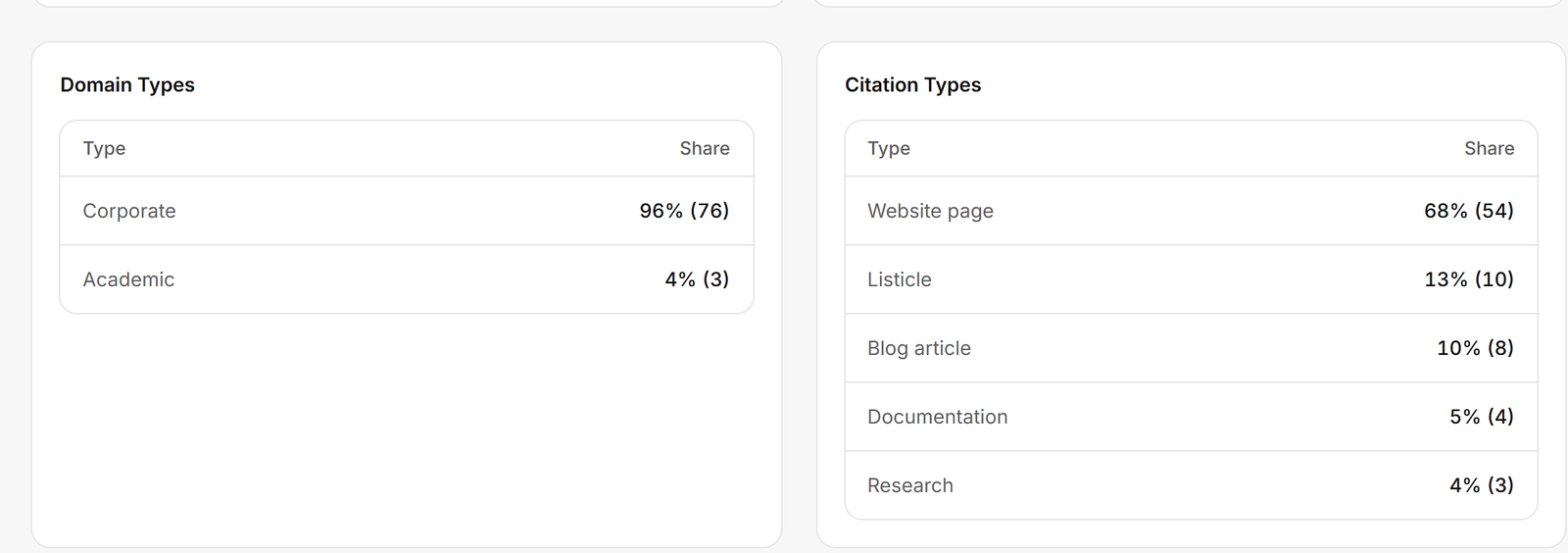
LiveMentions shows this under Sources, including how cited sources split by domain type and citation type.
7. Keep key pages current (reasoned, not documented)
OpenAI describes ChatGPT search as a way to answer questions with current information. A page that answers a question whose answer changes, such as pricing, comparisons or “best of” lists, is more useful when it is current. No source in this guide shows that changing a date raises citation odds, so update the content, not just the date shown.
First step: pick the pages that answer questions with a changing answer and review them on a fixed schedule.
What OpenAI does not promise
OpenAI’s page is direct: ChatGPT ranks search results using multiple factors, and placement is not guaranteed. It publishes no ranking formula. It also says that search results and citations can be incomplete, outdated, or incorrect, which is a reason to check what is actually cited instead of assuming.
Two more facts shape what you can do. First, ChatGPT search typically rewrites a question into one or more targeted queries, so one question can become several searches. Second, ChatGPT search sometimes partners with other search providers, and OpenAI’s page names Microsoft and Shopify in its list of providers whose privacy statements apply. OpenAI does not publish how results from providers are combined. It is sensible to confirm that your site is indexed by Bing as well as Google. That advice is reasoning, not an OpenAI instruction.
How can you check whether it is working?
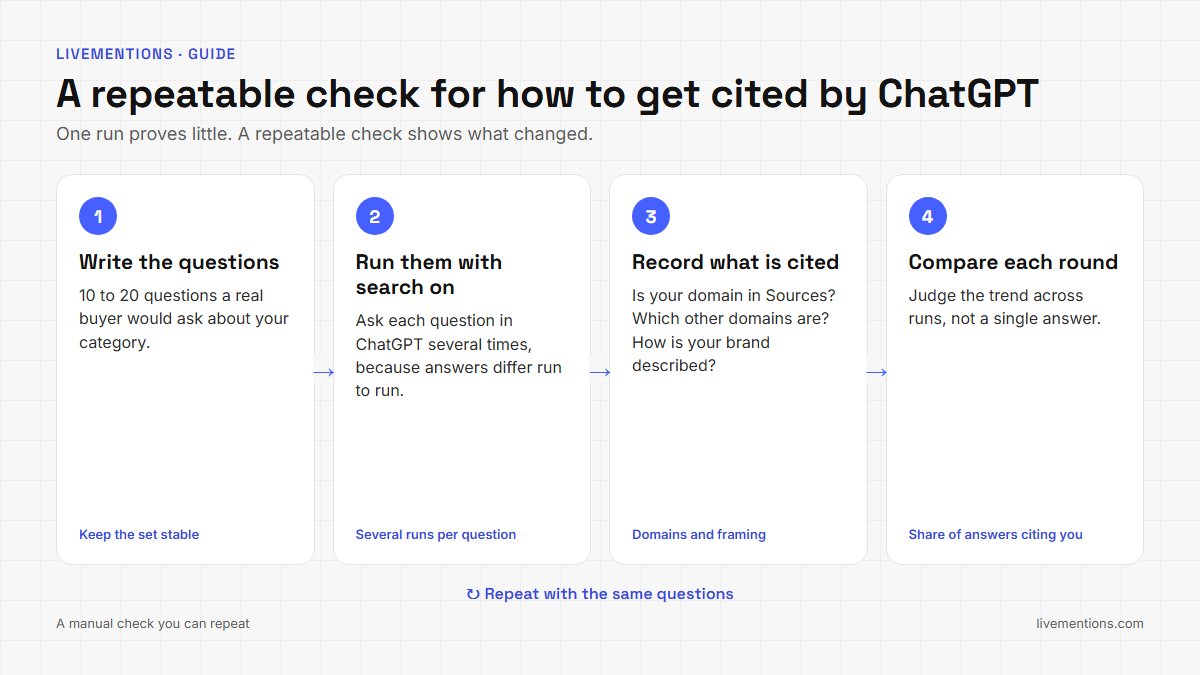
One answer from one run proves very little: answers differ from run to run, and OpenAI itself warns that citations can be incomplete or outdated. A repeatable check works better:
- Write 10 to 20 questions a real buyer would ask about your category.
- Run each question in ChatGPT with search turned on, several times, and record whether your domain appears in the Sources view.
- Note which other domains are cited, and how the answer describes your brand.
- Repeat with the same questions and compare the results, not single answers.
Referral traffic is a second signal. In the answers LiveMentions has captured, the links ChatGPT shows carry a utm_source=openai parameter, and in the LiveMentions Google Analytics property a visit from ChatGPT shows up with the source chatgpt.com. Filter for both when you watch that number over time.
LiveMentions runs this check for you. It sends your buyer questions to ChatGPT, Perplexity, Gemini and Claude, keeps the complete answers, and shows which sources each answer cites. The guide to AI citation tracking explains how to read that data, and the guide to prompt management shows how to build a stable question set.
Frequently asked questions
Does blocking GPTBot stop ChatGPT from citing my site?
OpenAI lists GPTBot as the crawler for content that may be used to train its models and OAI-SearchBot as the one for search results. They are separate user agents with separate purposes, so a rule for GPTBot is not a rule for OAI-SearchBot.
How long until a page is cited by ChatGPT after a robots.txt change?
OpenAI's crawler documentation says a change can take about 24 hours to take effect for search results. OpenAI publishes no timeline for when a page becomes cited by ChatGPT, and it states that placement is not guaranteed.
Is a citation the same as a recommendation?
No. A citation is a link to a source used in the answer. A recommendation is the answer naming your brand as an option. A page can be cited without the brand being recommended, which is why both should be tracked. The guide to what AI brand visibility is covers the difference.
Does an llms.txt file help?
Neither OpenAI page used for this guide mentions llms.txt, so there is no documented effect on ChatGPT citations. If you add one, treat it as low-cost housekeeping, not as a citation tactic.
Start here: how to get cited by ChatGPT in thirty minutes
In the next thirty minutes, do three things. Check that OAI-SearchBot is allowed in robots.txt and at your CDN. Rewrite the first paragraph of your most important page so it answers its main question. Write down the ten questions you want ChatGPT to answer with your pages. Then use LiveMentions to track those questions across ChatGPT, Perplexity, Gemini and Claude and see, answer by answer, who gets cited by ChatGPT and who does not.
Ready to see your own AI visibility?
Start Free Trial
Shahin Salehin
I’m Shahin, founder of LiveMentions and a software product builder with years of experience building WordPress plugins and tools for real businesses. My work has given me a practical perspective on product development, search, content, and how businesses build visibility online. With LiveMentions, I’m now focused on AI search and helping brands understand how they are represented across AI-generated answers. I write about AI brand visibility, AI search, and practical strategies based on research, experimentation, and what I learn from building in this space.
Articles: 18