
AI brand accuracy is how closely the answers AI assistants give about your brand match the facts you can prove: your founding year, what you sell, who you serve. The AI accuracy check in LiveMentions measures it by comparing recent AI answers with the facts you saved in Brand Context. It sorts every difference into one of two findings, a Contradiction or Not covered, and shows the exact words and the engine.
Why do AI answers get facts about a brand wrong?
OpenAI says so itself. Its help article on whether ChatGPT tells the truth states that the model can produce incorrect or misleading outputs and may sound confident when it is wrong. The examples it lists include incorrect definitions, dates or facts.
Search does not remove the problem. OpenAI's page on web search says that search results and citations can be incomplete, outdated, or incorrect. Anthropic describes the same behavior for Claude: even the most advanced models can generate text that is factually incorrect or inconsistent with the given context.
For a brand this matters because the wrong sentence is read by a buyer who never visits your site. A wrong founding year is a small error. A wrong pricing model or a wrong audience can send a buyer to a rival. You cannot read every answer by hand, and a facts-versus-answers comparison is the step that is easy to skip.
What are the two kinds of finding?
The check reports two kinds of finding, and they ask you to do different things.
| Finding | What it means | Example with a made-up brand | What you do |
|---|---|---|---|
| Contradiction | An answer says something that conflicts with one of your facts. | Your fact says founded in 2021. An answer says founded in 2019. | Open this fact and check which side is wrong. |
| Not covered | An answer makes a specific claim about your brand that none of your facts mention. | An answer says the product includes a free trial. No fact mentions a trial. | Decide whether the claim is true and add it, or dismiss it. |
The LiveMentions Docs describe a Contradiction as an answer that conflicts with a fact, such as a different founding year or pricing model. Not covered is a specific claim that none of your facts address. An answer that agrees with your facts does not show up as a finding.
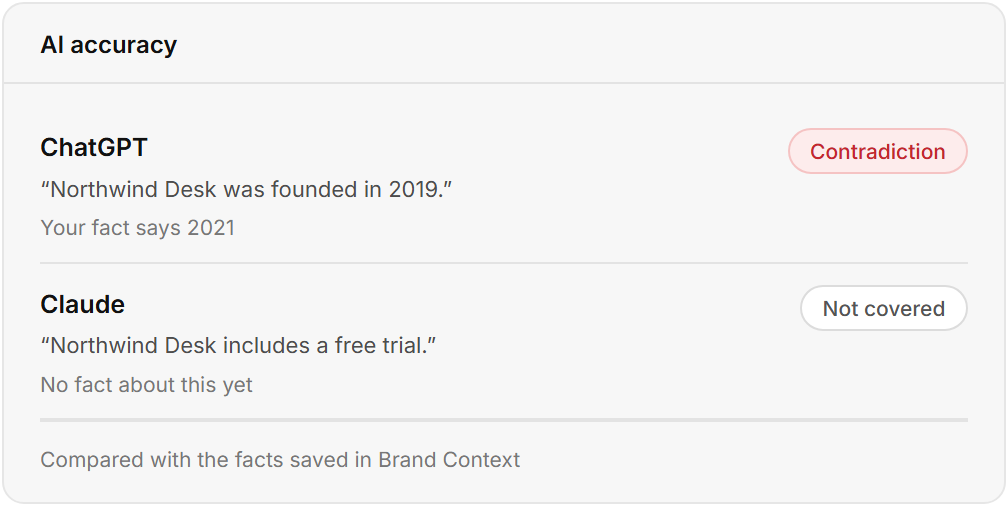
The card above comes from the public Brand Context page and uses a made-up brand. It shows the format of a real finding: the engine, the exact sentence, the fact it conflicts with, and a label.
How does the AI accuracy check work?
The check compares two things you already have in LiveMentions: the answers it tracks and the facts in Brand Context.
- The facts. Brand Context is the page where LiveMentions keeps what it knows about your brand. The check compares answers with three parts of it: Offerings, Audience and the Company overview. LiveMentions AI reads your website and fills in what it can, you edit any line, and every field shows its source: AI from your site, AI from your tracked answers, or Written by you.
- The answers. The check takes the recent answers LiveMentions has tracked for your project across the AI engines and finds the sentences about your brand.
- The comparison. Each sentence is compared with your facts and reported as a Contradiction, as Not covered, or not at all.
The panel in the product states what it does not do: it only reads answers that are already tracked, and it never changes an answer or your visibility numbers. That keeps the check separate from measurement. The Docs add that Brand Context is never added to the questions LiveMentions sends to AI engines, so your facts do not shape the answers you compare them with.
The check is part of the paid plans, and there is a 7-day free trial.
What does an AI brand accuracy check look like on a worked example?
The example below is invented to show the format. The brand, the fact and the answers are made up, and nothing in it is a benchmark.
Northwind Desk is a made-up invoicing tool. Its saved facts say it was founded in 2021 and serves freelancers and small agencies. Three answers about it arrive from three engines.
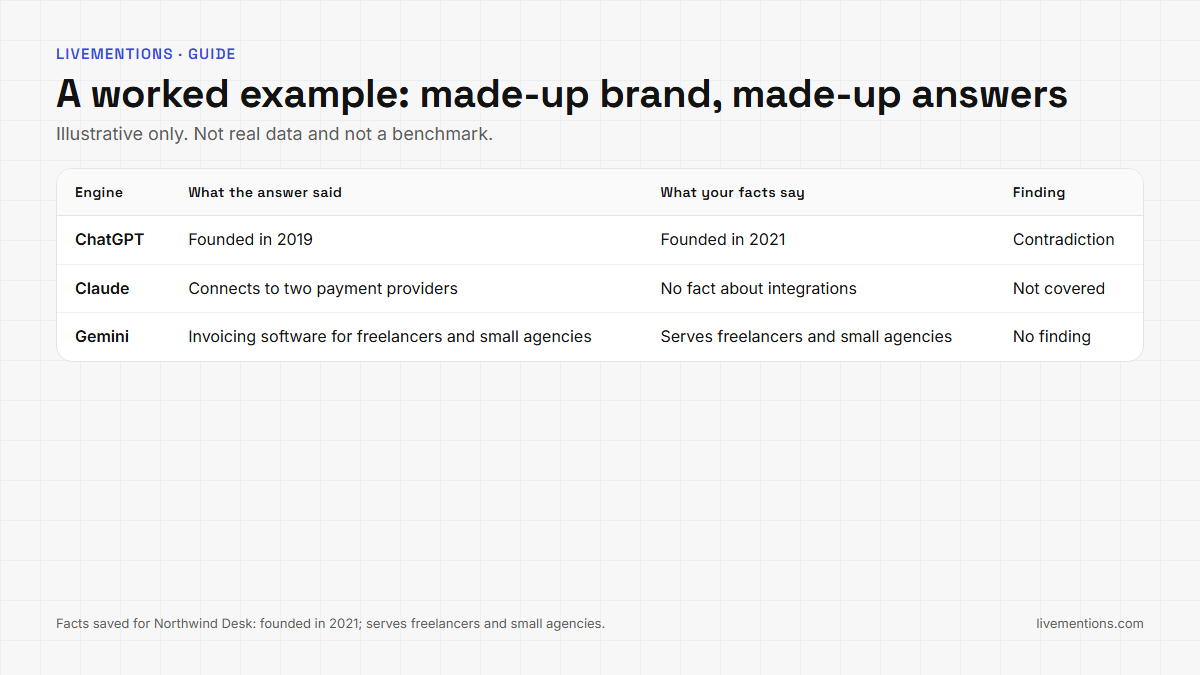
Read the table from left to right. The first answer conflicts with the saved founding year, so it is a Contradiction. The second makes a specific claim about integrations that the facts never mention, so it is Not covered. The third agrees with the facts and produces no finding.
The same sentence can mean different things. If the saved fact was wrong and the answer was right, the finding is still useful, because it shows the fact needs to change. That is why every contradiction links back to the fact it conflicts with.
Which side is wrong, the answer or the fact?
A check of AI brand accuracy compares answers with what you saved, so its result is only as good as the facts. Two habits keep it useful.
Confirm your facts first. When LiveMentions AI fills in Brand Context from your site, the fields carry the label AI from your site until you confirm or edit them. In the real panel below, a note says that all nine saved facts were read from the site and not yet confirmed, and asks you to confirm or edit them to get firmer results. Read each fact once and fix anything that is stale.
Add the true claims. A Not covered finding can be correct. The panel says these claims may be true and offers Add it to your facts, so that the assistant and agents can use them. Adding a claim saves it with your facts, so you decide what is on record.
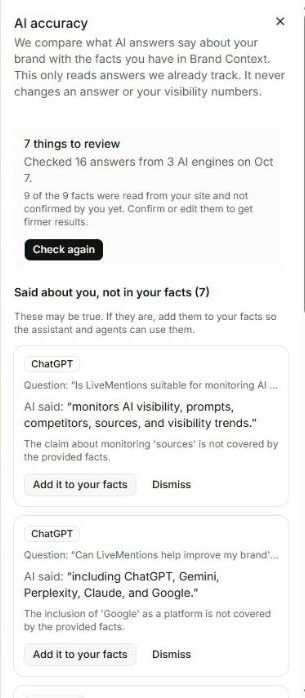
Use Dismiss when a finding is not a problem, such as a claim that is true but too minor to record. The finding is removed from the list.
What do you do with a Contradiction?
The check finds the claim. Improving AI brand accuracy still means correcting what people read, and that follows the same order each time.
- Check your own fact. Use Open this fact to see the statement the answer conflicts with. If your fact is out of date, correct it in Brand Context.
- Find where the claim could come from. The Sources page lists the websites AI cites for your tracked questions, so you can read the pages that the same answers rely on. OpenAI advises opening a cited source to check that it supports the answer.
- Correct the pages you control. Change the sentence on your own site, then match your profiles and listings to it. Keep one wording for each fact on every page.
- Make sure the bots can read the pages. A blocked search bot cannot read your corrected page. Crawlability shows which AI bots your robots.txt lets in.
- Look again later. The next time you run the check, the finding either disappears or comes back with a new sentence to read.
LiveMentions finds the contradiction and points to the fact. It does not edit an AI answer, and it does not promise a particular answer from any engine.
What does the AI accuracy check not claim?
Four limits are worth knowing before you read a list of findings on AI brand accuracy.
- It reads tracked answers only. The check does not see every answer every person receives. It compares the answers LiveMentions has recorded for your project.
- It needs facts to compare. With no saved facts the card says Add some facts first. With no tracked answer that mentions your brand it says Nothing to check yet.
- It does not decide what is true. It compares answers with your saved facts. If a fact is wrong, a correct answer can show up as a Contradiction.
- It never edits an answer or your visibility numbers. Your visibility data stays an honest measurement of how AI talks about your brand today.
How does LiveMentions fit AI brand accuracy into your workflow?
LiveMentions is an AI brand visibility platform. It tracks how often, and how favourably, a brand appears in answers from ChatGPT, Claude, Gemini and Perplexity, compares it with competitors, shows which sources the AI cites, and suggests ways to improve (the Optimize feature).
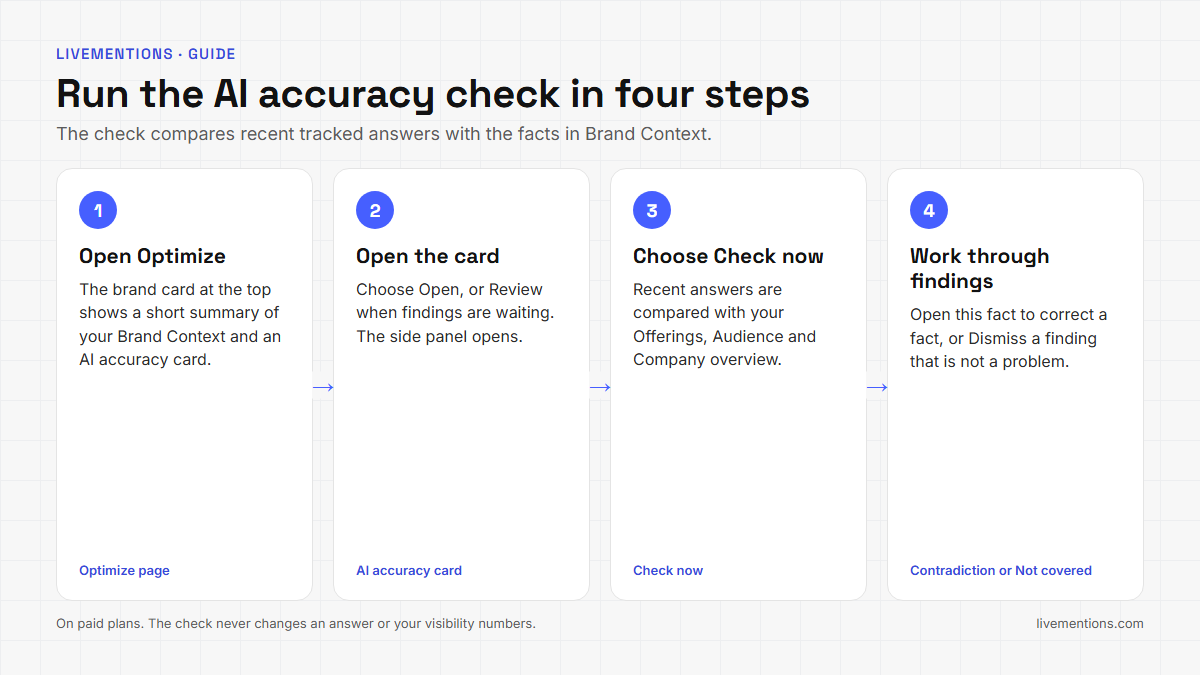
The AI accuracy check sits on the Optimize page, where the brand card at the top shows a short summary of your Brand Context and an AI accuracy card. Choose Open, or Review when findings are waiting, then Check now. Read what Brand Context holds before you start, and the AI accuracy check guide for the exact steps. The same tracked answers also feed the mentions, citations and framing described in the guide to what AI brand visibility is.
Frequently asked questions
What is AI brand accuracy?
It is how closely the answers AI assistants give about your brand match the facts you can prove. LiveMentions measures it by comparing recent tracked answers with the facts saved in Brand Context and listing each difference as a Contradiction or as Not covered.
What is the difference between a Contradiction and Not covered?
A Contradiction is an answer that conflicts with one of your saved facts, such as a different founding year. Not covered is a specific claim about your brand that none of your facts mention. A Contradiction asks you to check a fact, and Not covered asks you to decide whether to add one.
Does the AI accuracy check change what ChatGPT says about my brand?
No. The check reads answers that are already tracked and never changes an answer or your visibility numbers. It tells you where answers and facts differ, so you can correct the pages and facts you control.
Which plans include the AI accuracy check?
It is part of the paid plans, and a 7-day free trial is available. You can write and edit Brand Context on every plan.
Start with three facts, then run the check
Open Brand Context and confirm three facts that a wrong answer would hurt most: what you sell, who it is for and when you were founded. Then open Optimize and run the AI accuracy check. Every Contradiction is a sentence a buyer may already have read, and every Not covered finding is a claim you can now confirm or dismiss. Start from the Brand Context page and see where AI gets it wrong.
Ready to see your own AI visibility?
Start Free Trial
Shahin Salehin
I’m Shahin, founder of LiveMentions and a software product builder with years of experience building WordPress plugins and tools for real businesses. My work has given me a practical perspective on product development, search, content, and how businesses build visibility online. With LiveMentions, I’m now focused on AI search and helping brands understand how they are represented across AI-generated answers. I write about AI brand visibility, AI search, and practical strategies based on research, experimentation, and what I learn from building in this space.
Articles: 24